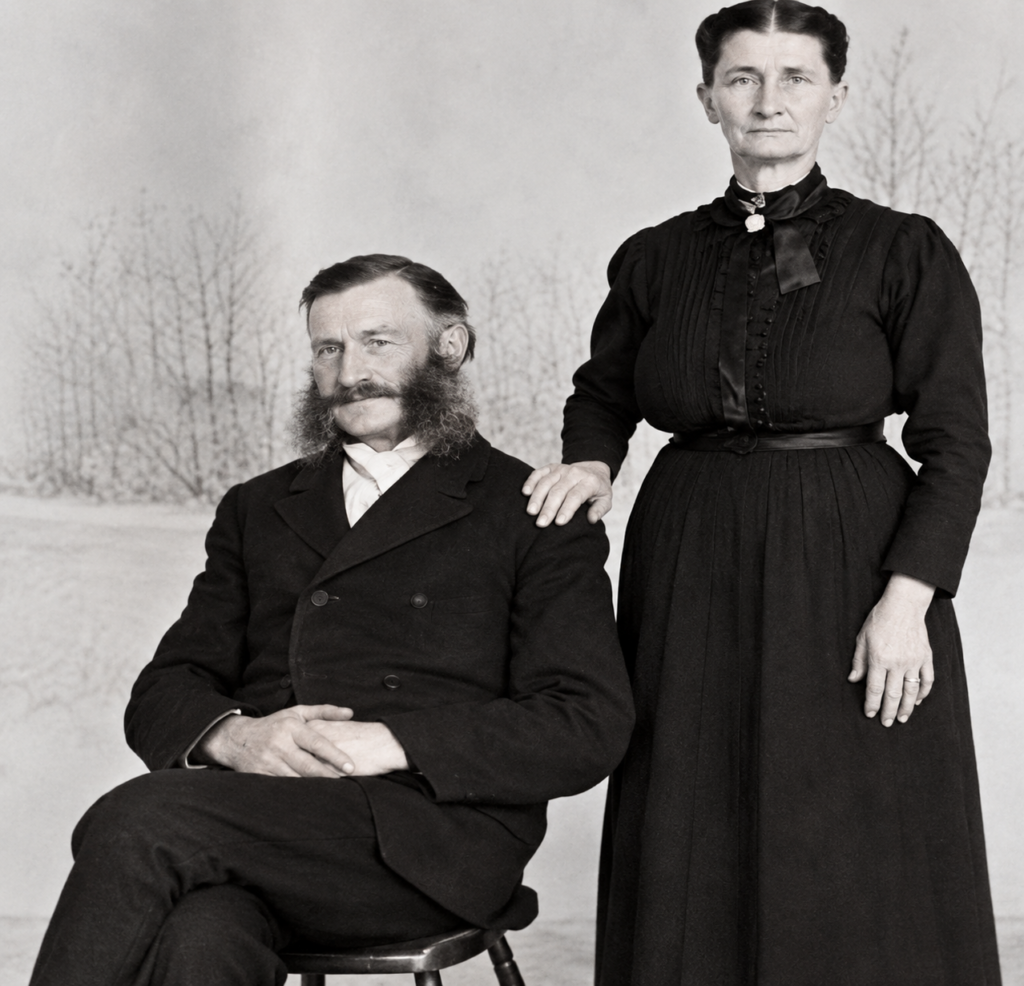
G7 - Thomas Shiels (1857-1928) & Rachel Brigham
Thomas Shiels was born on December 9, 1857 near Cranbrook, Ontario, the eldest of nine children of John Shiels and Janet McNair. He grew up on the 100-acre farm his father had carved from the Grey Township bush after coming to Canada from Scotland.
A Restless Spirit — Looking West
Thomas grew into a very tall man, standing nearly a head above most men. But it was not only his height that set him apart. Like his father before him, Tom had a strong desire to see what lay beyond the familiar world in which he had grown up.
His father John had crossed the Atlantic in search of a new life. A generation later, Thomas would make his own journey — first into the forests of northern Ontario, then west to Manitoba, and finally onto the open prairie of Saskatchewan.
At his side through much of that journey was Rachel Ann Brigham, a remarkable woman whose courage, faith and willingness to help others would become as much a part of their story as Tom’s determination to keep moving west.
Thomas & Rachel — An Unexpected Courtship
Rachel Ann Brigham was born on November 4, 1858 in King Township, York County, Ontario, the eldest child of George and Jane Tatton Brigham. Times were difficult, and at just twelve years old Rachel went out to work for five dollars a month, sending all of her earnings home to help her family.
As a young woman Rachel had more than one admirer. One young man in particular had caught her attention, until she discovered that he “liked the bottle.” For Rachel, that settled the matter.
Her eventual courtship with Thomas Shiels began almost by accident. Tom’s mother, Janet McNair, had arranged for Tom’s younger brother James to accompany Rachel to a dance. James had a bad leg, and when the evening was over he was unable to catch his horse. His older brother Thomas came to the rescue and took Rachel home.
Somewhere along the way, the arrangement changed. Thomas and Rachel fell in love.
On October 31, 1883, twenty-six-year-old Thomas Shiels married Rachel Ann Brigham at Brussels, Ontario. They would spend the next forty-four years together, and their life would eventually carry them more than 2,000 kilometres from the Ontario farms where they had grown up.
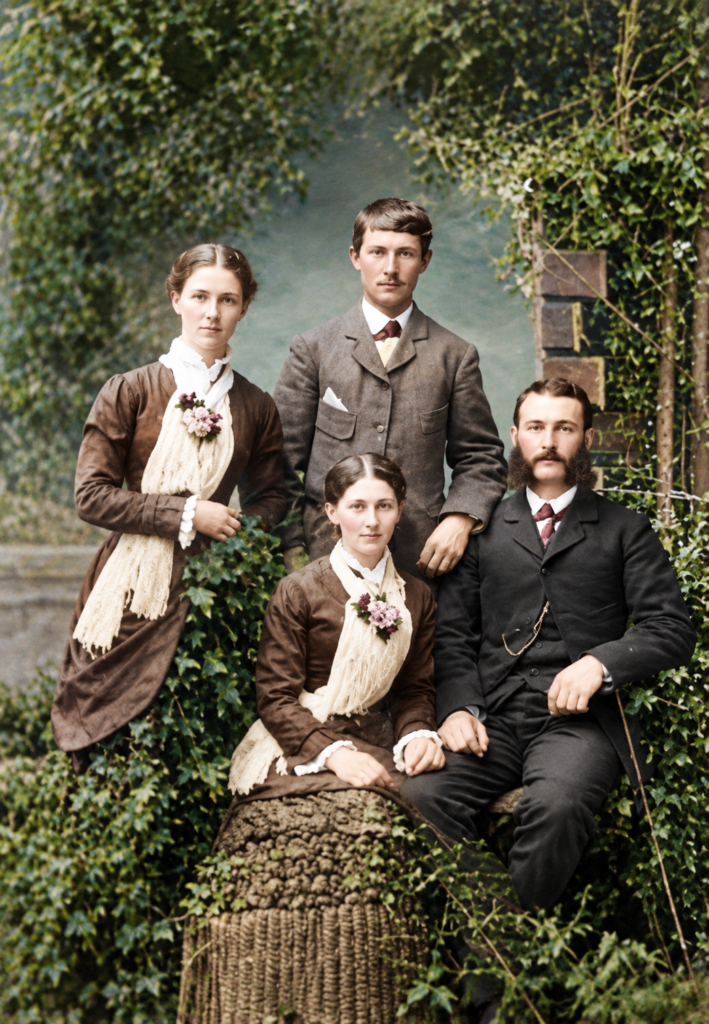
A Farm of Their Own — Trout Creek, 1891
After their marriage, Thomas and Rachel remained in the Brussels area, where their first child, John George Shiels, was born on February 17, 1885. For eight years they farmed near the families and countryside they had known all their lives.
But Thomas was ready to strike out on his own. He purchased 200 acres near Trout Creek, in the Parry Sound district of northern Ontario. The property was almost entirely bush, covered with beautiful stands of beech and maple. In 1891, Thomas and Rachel left the familiar farmland of Grey and Huron Counties and moved north to begin again.
Their daughter Lottie Jane Shiels was born there on February 28, 1893. Thomas farmed the land and worked during the winters in the local lumber mills, where the hardwood from the surrounding forests was sawn into lumber.
Rachel's Fight for Life
While the family was living at Trout Creek, Rachel became seriously ill. A large tumour had developed on her back, extending over her hip and nearly to her waist. It continued to grow until it was draining away her strength.
There was no nearby hospital where Rachel could be treated, so a young doctor faced the extraordinary task of performing the operation in the Shiels home. The family’s kitchen table became his operating table.
Rachel’s courage became part of the family story. Before the operation began, she threaded the needles the doctor would need and then climbed onto the kitchen table herself. As the chloroform began to take effect, Rachel—whose faith was very important to her—started singing a hymn.
Thomas could only wait outside, tears in his eyes and fearing that he might lose his wife. During the operation Rachel’s condition became so critical that the doctor twice had to stop and revive her.
Against the odds, the operation succeeded. The tumour that was removed reportedly weighed twelve pounds. Rachel recovered and, according to the family account, was soon “her old self again.” The Shiels family remained at Trout Creek until 1898.
This story was preserved in a taped conversation with Thomas and Rachel’s daughter, Lottie Jane Burdett, during a visit with Dan Shiels in Tisdale, Saskatchewan, in September 1982. Lottie was 89 years old and recalled the events and family stories of her younger years with remarkable clarity.
The Call of the West
By 1898, Thomas had developed a strong desire to see the Canadian West and the great prairies beyond Ontario. He first looked for work closer to home, but when none was available, he set out on foot looking for opportunity.
He kept walking west.
Eventually Thomas reached Winnipeg, Manitoba, having travelled an extraordinary distance on foot from the Trout Creek area. After staying briefly with relatives, he continued southwest to Killarney, Manitoba, where he found work on a farm.
Thomas sent word back to Rachel with instructions to sell their 200-acre bush farm and prepare to join him. The land they had worked since 1891 was sold for just one dollar an acre. Rachel packed the family’s belongings, and in 1899 she, John and Lottie boarded a train bound for Winnipeg.
Their journey bore little resemblance to modern rail travel. A small heater in the corner warmed the coach, the seats had no cushions, and there was no dining car. At night passengers made their beds wherever they could. The trip took four days and four nights.
Thomas was waiting when the train finally arrived in Winnipeg. After spending a few days there, the reunited family continued on to Killarney and the next chapter of their lives.
The Golden West at Last — Killarney, Manitoba
When Thomas, Rachel, John and Lottie finally reached Killarney, they felt they had arrived in the “Golden West.” For the first time since leaving Trout Creek, the family could begin settling into a new life together.
Thomas’s farm job provided them with a house to live in. Rachel soon found work cooking for their landlord, who was preparing to marry and building a new home. Before long, Thomas purchased a house and half an acre of land in Killarney, and John began attending school.
Thomas then secured steady employment with the railway as a section man, earning $1.25 a day. After the uncertainty of Trout Creek and the long journey west, the Shiels family once again had a home, work and a community around them.
Thomas and Rachel became involved with the Methodist Church in Killarney. Rachel joined the church’s Missionary Society, helping pack boxes of clothing for those in need and baking to raise money for the church. Her willingness to help others — a quality that would become especially important during their later years on the Saskatchewan prairie — was already very much a part of her life.
Yet Thomas had not come west simply to work for someone else. Beyond Manitoba, great areas of prairie were being opened for homesteading. The possibility of owning land of his own was about to draw him west once again.
A Homestead of His Own — 1902
In 1902, new homestead lands were being opened farther west on the Saskatchewan prairie. For Thomas, the opportunity was difficult to resist. After years of working other people’s land, he could finally claim a farm of his own.
In September 1902, Thomas filed for a homestead and obtained entry for the N.E. ¼ of Section 24, Township 11, Range 8, West of the Second Meridian — 160 acres of prairie in what was then known as the Lost Horse District, later called Glenada.
Thomas and Rachel were both troubled by illness, however, and he could not immediately take possession of the land. A friend, Dan McLeod, helped protect Thomas’s claim until he was able to make the journey west.
Finally, on June 15, 1904, Thomas arrived at his Saskatchewan homestead.
What awaited him was very different from the Ontario bush he had known. There was no established farm waiting for him. Thomas had to create one. During that first summer he built a kitchen and broke fifteen acres of prairie, beginning the long process of turning his homestead claim into a working farm.
Rachel had been ill during the spring, so Thomas remained on the homestead for only about three months before returning to Killarney for the winter. The family was still divided between their established home in Manitoba and Thomas’s new piece of prairie hundreds of kilometres farther west.
Building a Farm on the Prairie — 1905–1907
Thomas returned to the homestead in March 1905, determined to continue what he had begun the previous summer. That year he seeded and cropped twenty acres and broke another six acres of prairie.
It was not an easy beginning. Thomas had arrived with three horses, essential to virtually every part of establishing a prairie farm. By the end of June, two of the three were dead. Yet he continued working the land and preparing for the day when Rachel and the rest of the family could finally join him.
In March 1906, Thomas began enlarging the little homestead house, adding a front section to the kitchen he had built earlier. The time had finally come to move the family permanently from Killarney to Saskatchewan.
Their son John travelled ahead in a boxcar with the family’s livestock and possessions, while Rachel and Lottie followed by passenger train three days later. Thomas and John met them at Stoughton, the nearest railway point.
Before setting out for the homestead, they stopped for dinner at a Stoughton hotel. For 25 cents each, they were served roast beef with all the trimmings, followed by pie and coffee — one of those wonderfully ordinary details that survived in the family story.
Neighbours arrived with teams and wagons to help carry the family’s belongings from Stoughton to the homestead. At last, nearly four years after Thomas had first filed his claim, Thomas and Rachel were together on their own Saskatchewan farm.
Their son John was beginning a life of his own nearby. He obtained a homestead on the S.E. ¼ of Section 30, Township 11, Range 7, West of the Second Meridian, only about half a mile from his father’s land.
Thomas continued improving his farm. During 1906 he broke another eleven acres and cropped twenty-one acres. By January 1907, his homestead included three horses, three cattle and two hogs, along with a house valued at $400, a stable valued at $25 and a granary valued at $25.
When Thomas applied for his patent on July 2, 1907, he had thirty-seven acres under crop, four cattle and four horses. His original small dwelling had grown as well: the records described a 12-by-12-foot house with a 16-by-18-foot addition.
On August 28, 1907, Thomas received the patent to his homestead. Five years after filing his claim — and almost half a century after his father John had begun carving a farm from the Ontario bush — Thomas Shiels finally owned the land he had come west to find.
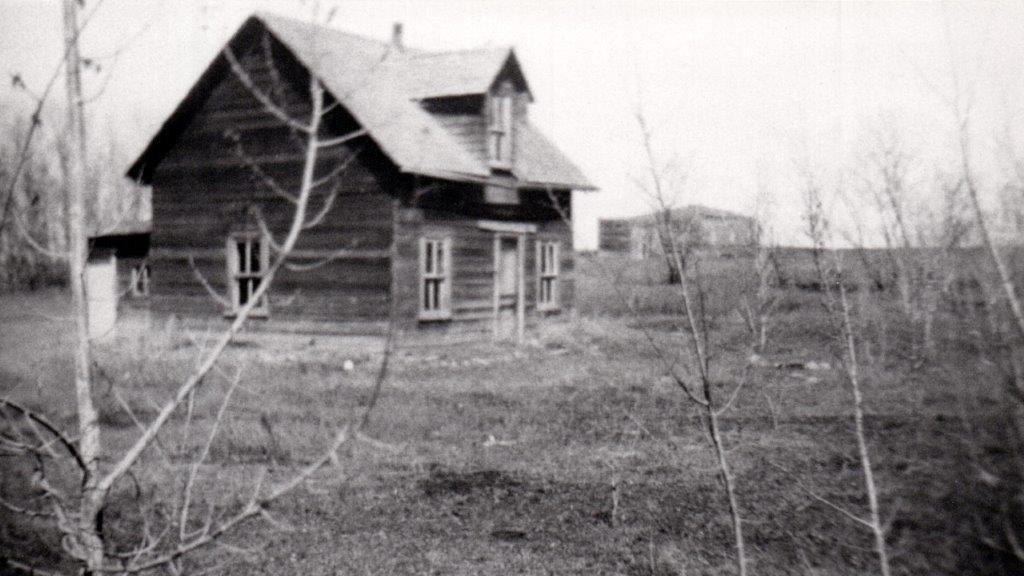
Life on the Saskatchewan Prairie
Receiving the patent did not mean the hard work was over. It meant that Thomas and Rachel had finally secured the land on which they could build their future. Over the following years, the little homestead became an established prairie farm and the centre of their family’s life.
The countryside around them was changing as well. When Thomas first arrived, mail was collected at Corning, while many supplies had to be brought from Stoughton. A man named Mr. Zink travelled through the district with a dray, bringing groceries and accepting eggs in exchange. Eventually a store opened in the Golden West District, about three miles west of the Shiels farm.
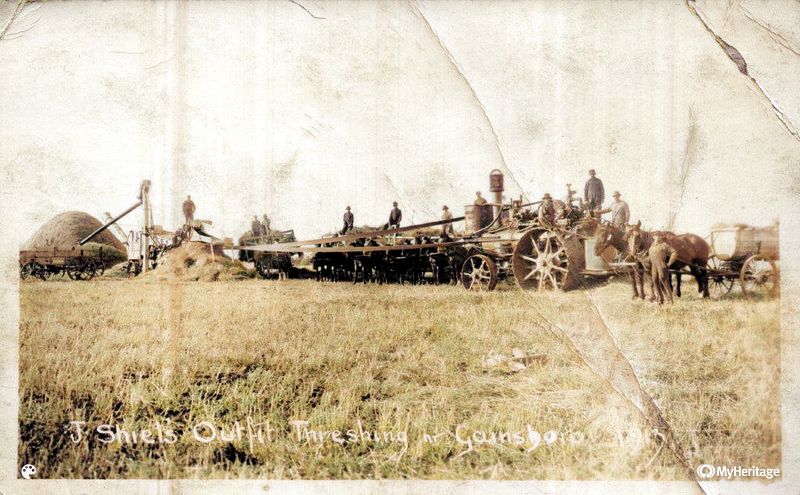
Farming remained demanding and intensely dependent upon neighbours. Seeding, harvesting and threshing brought people together, with men, horses and machinery moving from farm to farm as each crop became ready. The isolated homesteads were gradually becoming a community.
Church was part of that community as well. Thomas and Rachel had belonged to the Methodist Church in Killarney, and on the homestead services were held in the local schoolhouse. For Rachel especially, faith and service to others remained central to everyday life.
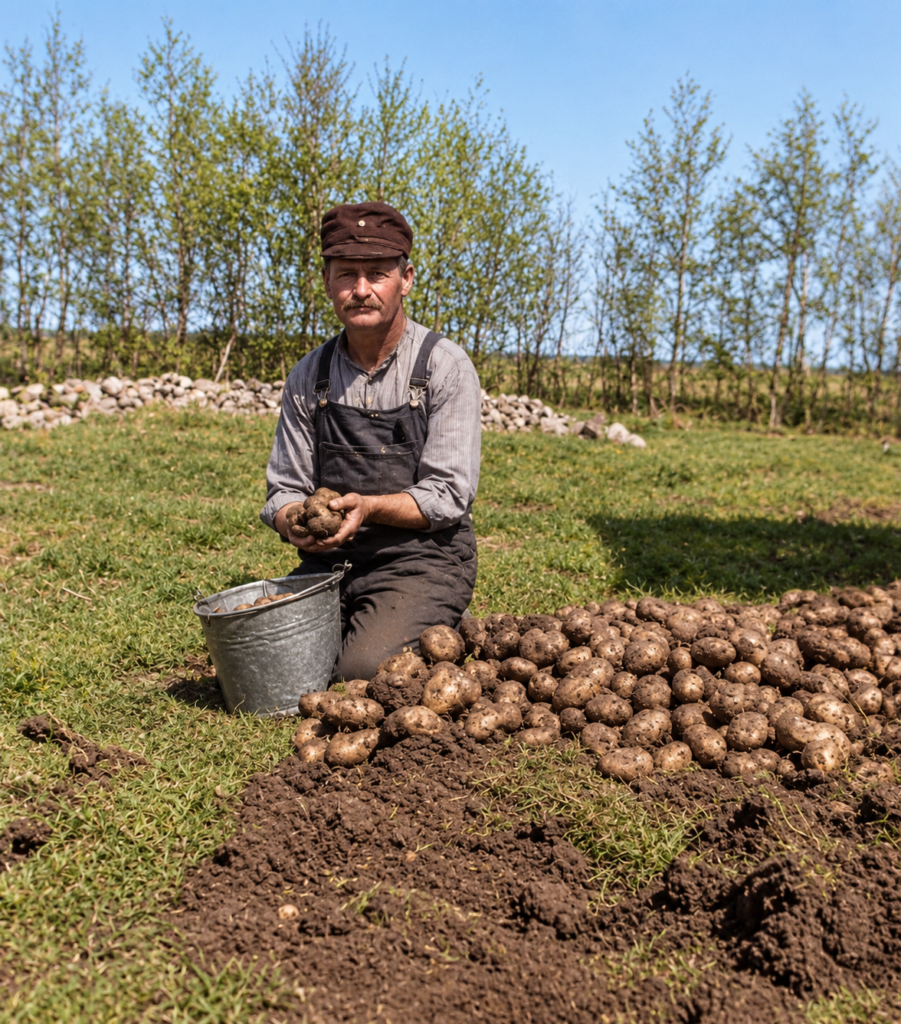
Rachel — A Neighbour in Time of Need
Life on an isolated prairie homestead demanded more than self-reliance. When illness or hardship struck, neighbours often depended upon one another — and Rachel became one of the people they could depend upon.
She baked bread for bachelors living alone on nearby homesteads and made sure they were not forgotten at Christmas, sometimes preparing a Christmas dinner for men who otherwise would have spent the day alone.
But it was when someone became ill that Rachel’s determination was most evident. Doctors and trained nurses were not readily available, and Rachel frequently helped care for sick neighbours. According to the family stories preserved by her daughter Lottie, Rachel would stay with a sick person and “fight for their life” as long as there was breath remaining.
She seldom received payment for what she did, nor does it appear that she expected any. Helping a neighbour was simply part of prairie life — and part of Rachel’s character.
There is something especially remarkable about this part of Rachel’s story. Years earlier at Trout Creek, she had been the desperately ill woman lying on her own kitchen table while a young doctor fought to save her life. On the Saskatchewan prairie, Rachel became the person who fought to save others.
Their Children Build Lives of Their Own
By the second decade of the new century, Thomas and Rachel had watched their Saskatchewan homestead grow from open prairie into an established family farm. Their children, John George and Lottie Jane, were now beginning to build lives of their own.
John had already taken up a homestead only about half a mile from his father’s land. On December 11, 1912, he married Pearl Gerry of Stoughton. The newlyweds spent their first winter on the Shiels farm before eventually establishing themselves on a farm south of New Hope and Stoughton.
John George’s story would carry the Shiels family into another generation — and forms the beginning of G8.
Lottie remained close to her parents. On July 14, 1920, she married Howard Burdett. For the first several years of their marriage, Howard and Lottie continued living with Thomas and Rachel on the family homestead.
In the fall of 1926, Howard and Lottie moved to their own farm on the S.E. ¼ of Section 25, Township 11, Range 7, West of the Second Meridian, just north of Thomas and Rachel. After years of separation and westward movement, Thomas and Rachel now had both of their grown children living nearby on the Saskatchewan prairie.
Thomas — The End of His Journey
By the beginning of 1928, Thomas had spent nearly a quarter of a century on the Saskatchewan prairie. The land that had once been an uncertain homestead claim had become his home, with his children and grandchildren living nearby.
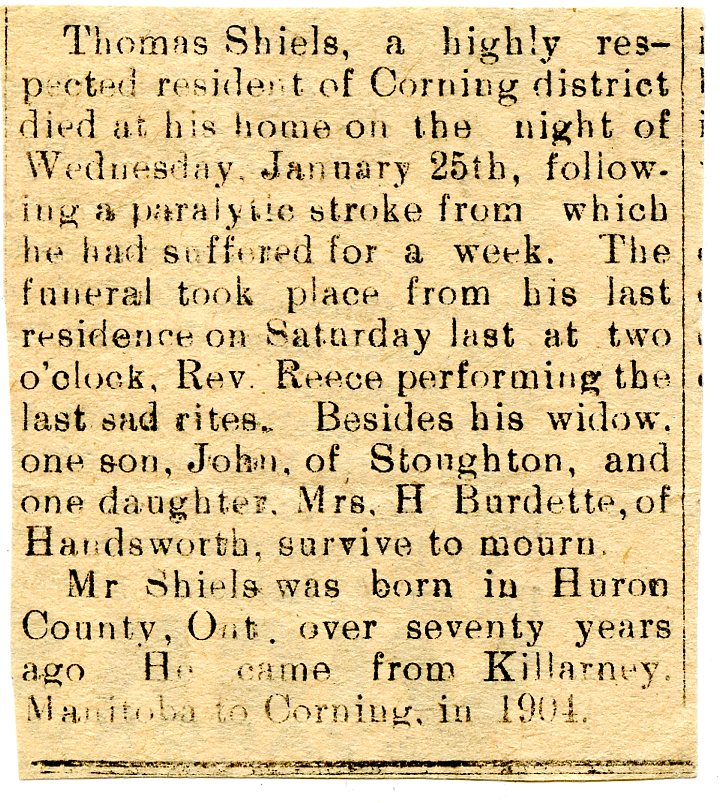
On January 19, 1928, Thomas suffered a paralytic stroke at his home near Corning. His condition was serious, and he never recovered.
Thomas Shiels died on January 25, 1928. He was seventy years old. He was laid to rest at Corning, Saskatchewan, leaving Rachel, their son John George and their daughter Lottie, along with the family and community that had grown around them.
Thomas’s life had carried him an extraordinary distance. He had been born on his father’s Ontario farm, moved north into the bush at Trout Creek, ventured west to Manitoba, and finally staked his future on the open Saskatchewan prairie.
The restless young man who had once set out from Ontario looking for the West had found it — and made it his home.
Rachel — One Last Journey
After Thomas’s death, Rachel remained on the Saskatchewan homestead. She was now seventy years old, but she was not entirely alone. Lottie and Howard lived nearby, and one of Rachel’s young granddaughters sometimes stayed with her for company.
The years that followed were difficult ones across the prairie. As the Depression deepened, Howard and Lottie decided to leave the Corning district and seek a new beginning farther north in Saskatchewan. Rachel chose to go with them.
Once again, after so many years of building a home, Rachel packed her belongings and prepared to leave.
The local storekeeper, Mr. Luke Deacon, drove Rachel, Lottie and the children north toward the Tisdale district, while Howard travelled separately by train with their livestock and furniture. The family initially stayed with Tom Stovin, spent a winter in the Willow Hill District, and later settled in the Eastman School District.
It was one final migration in a life that had already carried Rachel from the settled countryside of southern Ontario to the northern bush at Trout Creek, west to Manitoba, and onto a Saskatchewan homestead.
Rachel remained with her family in the Tisdale district for the rest of her life. She died in August 1939, more than eleven years after Thomas.
The Journey Continues
The story of Thomas and Rachel Shiels was part of a much larger journey. In 1850, Thomas’s father, John Shiels, had left Scotland and crossed the Atlantic in search of opportunity in Canada. Half a century later, Thomas felt much the same pull — not across an ocean, but toward the vast country that stretched west beyond Ontario.
Thomas brought much of the restless spirit that kept the family moving, but Rachel supplied much of the strength that allowed them to keep going. Together they left the familiar farms of Ontario, began again in the northern bush, crossed west to Manitoba and finally built a home on the Saskatchewan prairie. Their story was not simply one of migration. It was a story of perseverance, family, faith and the willingness to begin again.
And the journey did not end with them. Their son John George Shiels, born in Ontario in 1885 and carried west as a boy, would build a life and family of his own on the Canadian prairie.
The John George Shiels story continues with G8 below.