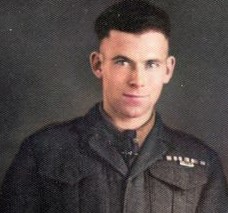
G9 - George Edwin Shiels (1922-1979) & Betty Jones
From the Canadian Prairies to the battlefields of Europe — and home again to build a family and a life.
George Edwin Shiels was born on May 21, 1922, near Stoughton, Saskatchewan, the eighth child of John George Shiels and Pearl Gerry. He was only eleven when his mother died. Four years later, the family left Saskatchewan and settled in the Bede area north of Melita, Manitoba.
In 1941, at the age of nineteen, George and his brother Howard joined the Canadian Army. What followed would take George far from the prairie world he knew—to Britain and across the battlefields of Europe—and ultimately lead him to a young Welsh woman named Mary Elizabeth (Betty) Jones.
That chance meeting in Wales would change both of their lives.
A Young Man Goes to War
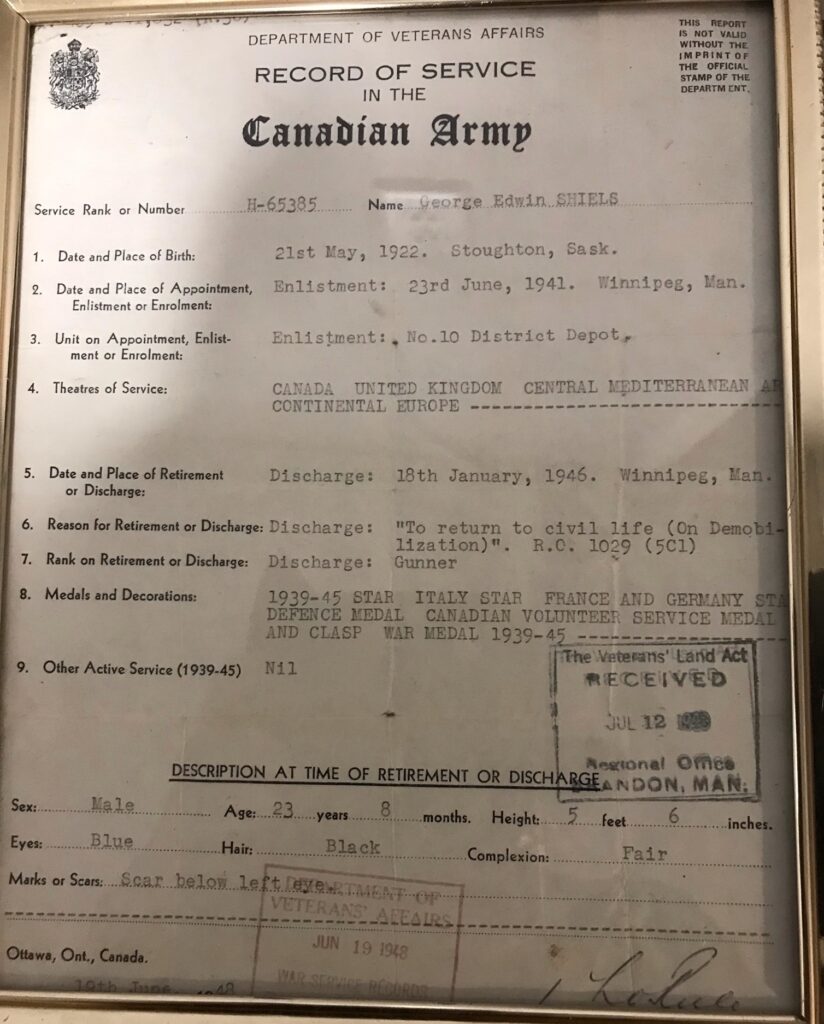
In June 1941, just a month after his nineteenth birthday, George enlisted in the Canadian Army in Winnipeg. His brother Howard also joined, and George soon found himself far from the farms and small communities that had shaped his early life.
George first served in Britain, where Canadian forces were helping defend the country while preparing for the campaigns that would follow. George’s wartime journey carried him through the Central Mediterranean and across Continental Europe. From Italy he later travelled through France and Belgium as Allied forces pushed northward toward the Netherlands.
Over the course of more than four years in uniform, George travelled thousands of miles through a world very different from the one he had left behind in Manitoba. His Army Record of Service shows that he finished the war as a Gunner and was discharged in Winnipeg on January 18, 1946.
He rarely spoke about his wartime experiences in later years, but the record he left behind tells something of the journey.
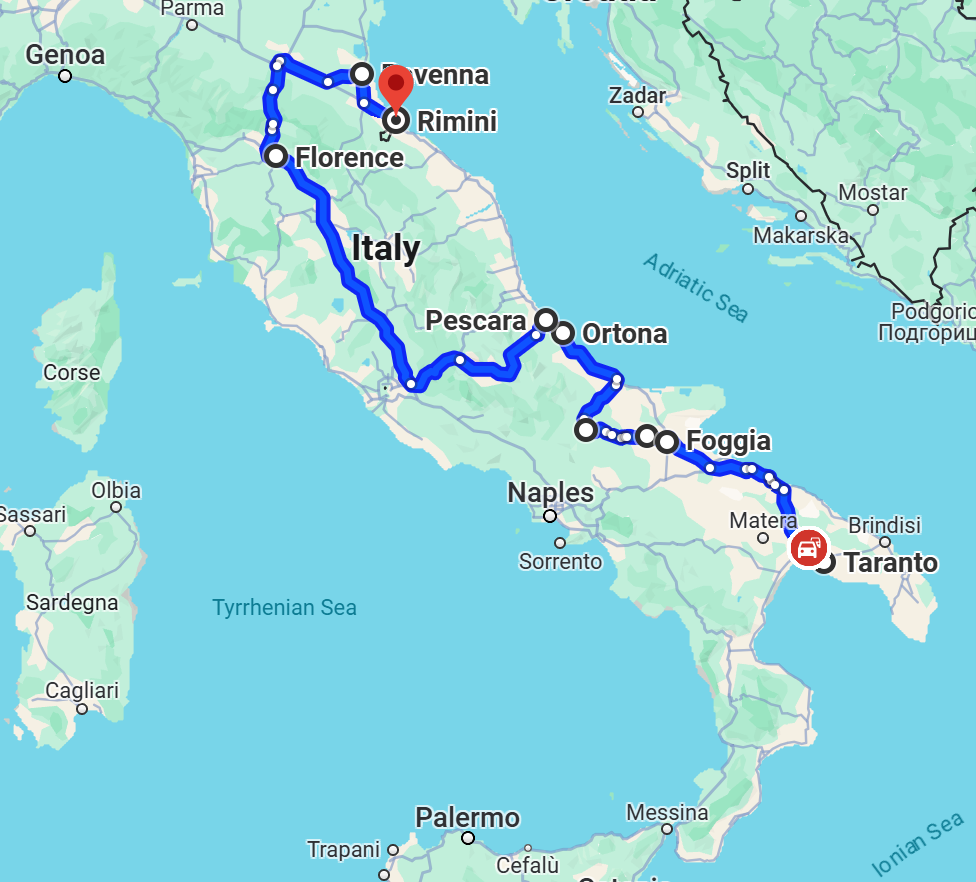
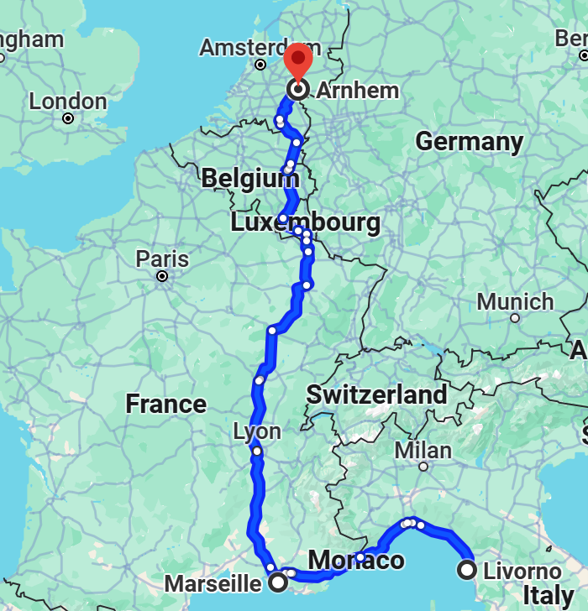
George’s wartime journey carried him across two major European campaigns. From Italy he later travelled through France and Belgium as Allied forces pushed northward toward the Netherlands. These maps help put into perspective just how far from home the young man from rural Saskatchewan and Manitoba had travelled.
A Pin in a Map Changes Two Lives
In the fall of 1942, George and two army friends, Laun Gannon and Bill Burack, were deciding where to spend their next leave. Rather than choose a destination in the usual way, they opened a map of Wales, closed their eyes and stuck a pin into it.
The pin landed on Bridgend, South Wales.
One evening in Bridgend, the three Canadian soldiers met two young Welsh sisters, Betty and Ray Jones, on a bridge. For George and Betty, the attraction was immediate.
Betty and Ray invited the young Canadians home to meet their family. Their mother, Gwladys Jones, welcomed them and offered to let the soldiers stay at the family home rather than pay for accommodation at the YMCA.
From then on, whenever George received leave, he returned to Bridgend — and to Betty.
A pin placed blindly on a map had brought George Shiels to the woman he would marry.
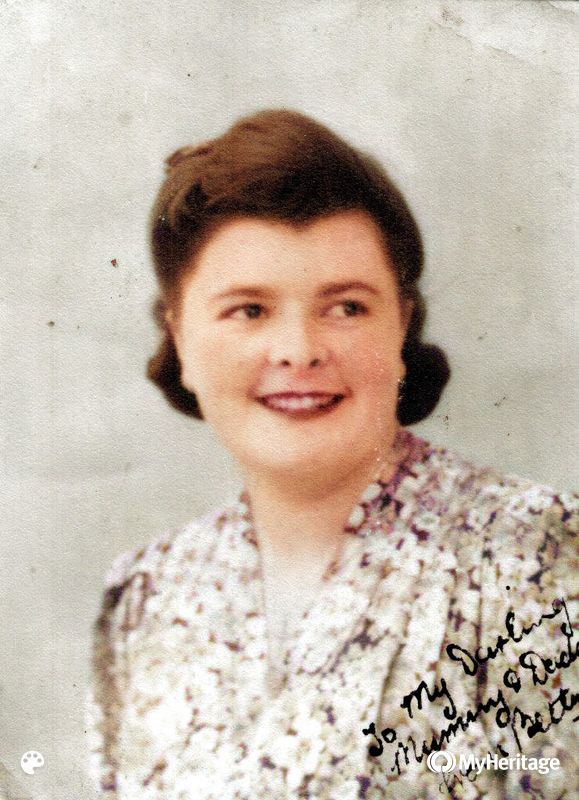
From Chance Meeting to Marriage
George’s army leave came every three months and lasted only seven days, but whenever he could, he returned to Bridgend to spend those precious days with Betty.
By the summer of 1945, with the war in Europe over, George had decided that Betty was the woman he wanted to marry. With the help of Betty’s youngest sister, Vi, he travelled to Cardiff one Saturday evening in August and chose an engagement ring.
The following day, George and Betty went to Newbridge Park in Bridgend, where George proposed. Betty said yes.
There was still one complication. As a Canadian soldier overseas, George needed permission from the Army to marry. Betty completed the necessary forms, permission was granted, and George received special leave for their wedding.
On October 6, 1945, George Edwin Shiels and Mary Elizabeth “Betty” Jones were married at the Welsh Independent Chapel in Bridgend. Betty’s brother Dewi served as best man, her sister Ray was maid of honour, and her youngest sister Vi was flower girl.
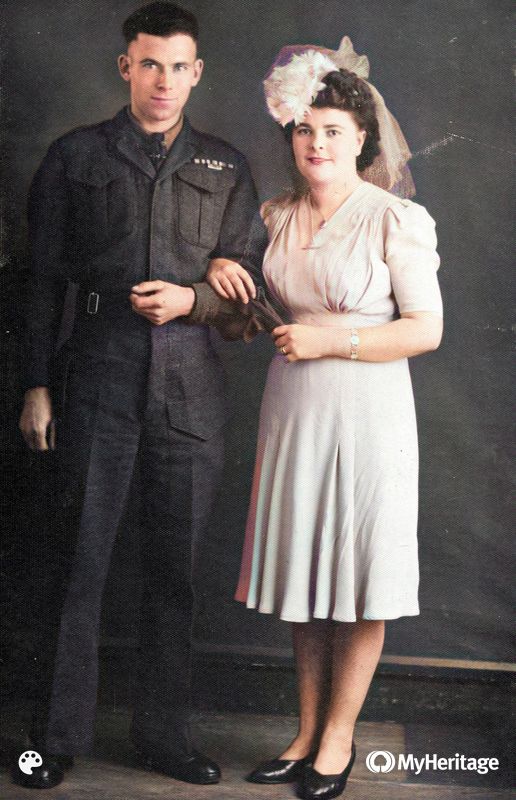
Their Wedding Day
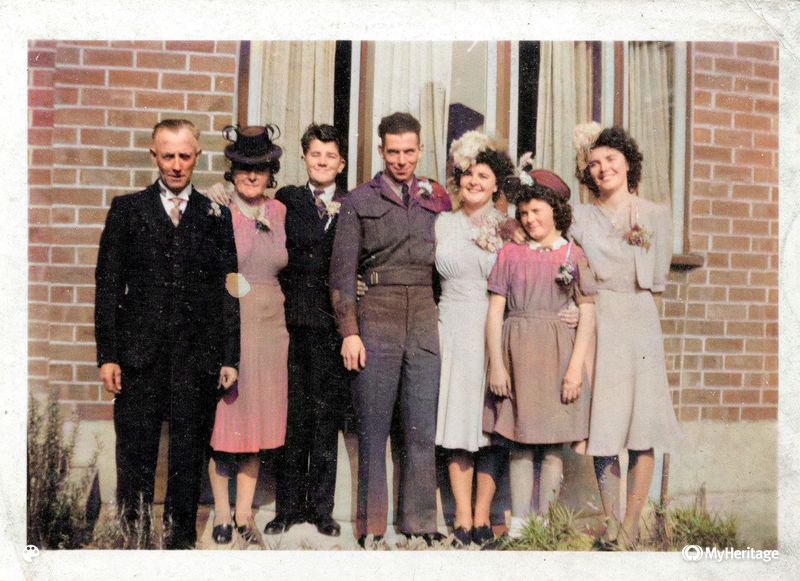
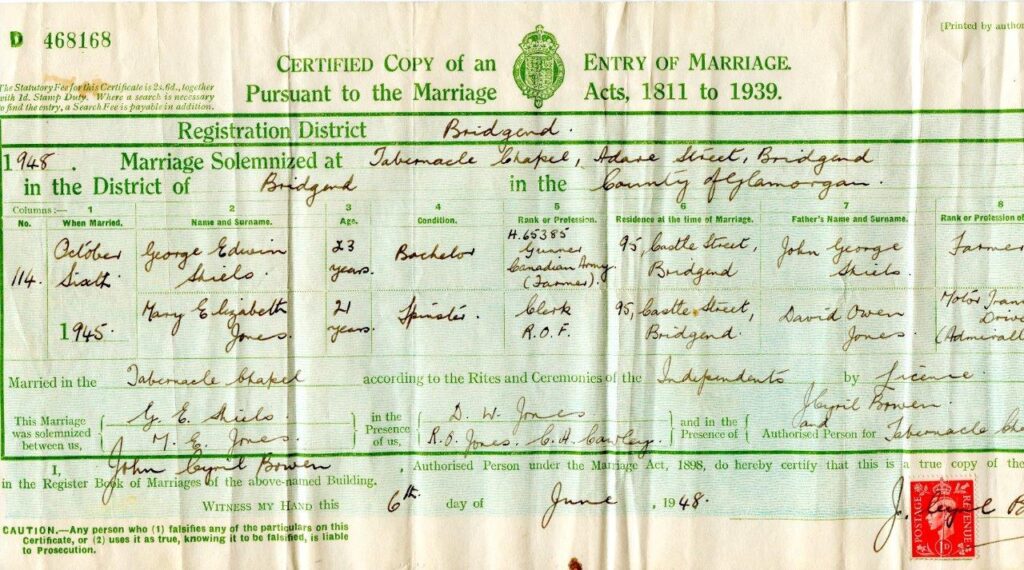
George and Betty’s wedding — October 6, 1945, Bridgend, South Wales.
Their marriage certificate records George Edwin Shiels, age 23, a Gunner in the Canadian Army, and Mary Elizabeth Jones, age 21. Their wedding brought together a young Canadian soldier and a Welsh woman whose lives had crossed only because of a pin placed blindly on a map.
A War Bride Comes to Canada
George and Betty had only a brief time together as husband and wife. After a one-week honeymoon, George returned to his unit. Three weeks later he was back in Bridgend for a final weekend with Betty before leaving England.
On October 27, 1945, George sailed from Southampton for Halifax. From there he travelled by train across Canada, arriving back in the Napinka area in November.
Betty remained behind in Wales. Before she could join George, she had to complete the necessary arrangements for her journey to Canada as a war bride. The wait would last more than seven months.
Finally, on June 9, 1946, Betty said goodbye to her family and left Bridgend. Her mother accompanied her as far as London, and Betty continued on to Southampton.
On June 11 — Betty’s 22nd birthday — she boarded the Queen Mary with other war brides and began her journey across the Atlantic to Canada.
The ship reached Halifax on June 14. Betty then boarded a train for the long journey west. On June 16 she arrived in Winnipeg, where George and his old army friend Laun Gannon were waiting to meet her.
The following day, George and Betty arrived in Melita. After nearly eight months apart, their life together in Canada could finally begin.
Building a Life in Manitoba
George and Betty’s first years together in Canada were filled with change. When Betty arrived in June 1946, George was working for Percy Brockington, and the young couple lived on Percy’s farm south of Melita. The women of the Peninsula district soon welcomed the young Welsh war bride with a shower at the local school.
Only three weeks after Betty arrived, George was rushed to Souris for an appendix operation. After his recovery, they lived for a time with George’s brother Ken, north of Napinka, before moving that fall to the old House farm at Broomhill.
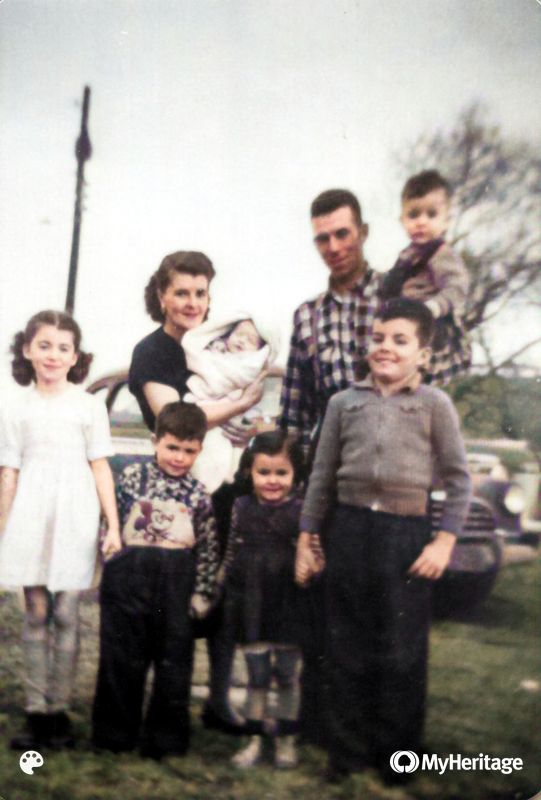
On June 2, 1947, their first child, Rosemarie, was born. David followed in 1948, Dan in 1951, Patty in 1952, Bill in 1955, Gareth in 1956 and Lynda in 1960.
Farming, railway work and a succession of rented homes followed as George and Betty worked to provide for their growing family. In 1952 they moved into Napinka, where George worked for the CPR while also working nights on Hector McInnes’s farm. Eventually he left the railway and worked for Hector full-time.
Through all those moves and changes, George and Betty were building something far more permanent than any particular house or farm — a family.
A Man Who Could Build Anything
By the mid-1960s, George’s working life began to change. In the fall of 1965, George and Betty purchased the old Will Gould house in Napinka. They completely remodelled it and added an addition, drawing on skills that George would soon turn into a new career.
George began working as a carpenter throughout southwestern Manitoba. He helped build a bridge west of Napinka, worked on the new Toronto Dominion Bank building in Deloraine, and on projects in Medora, Melita and Brandon. He also remodelled homes and built cupboards for families throughout the area.
But George did not need a set of plans to tell him how to make something. If he needed it, he often simply figured out how to build it himself.
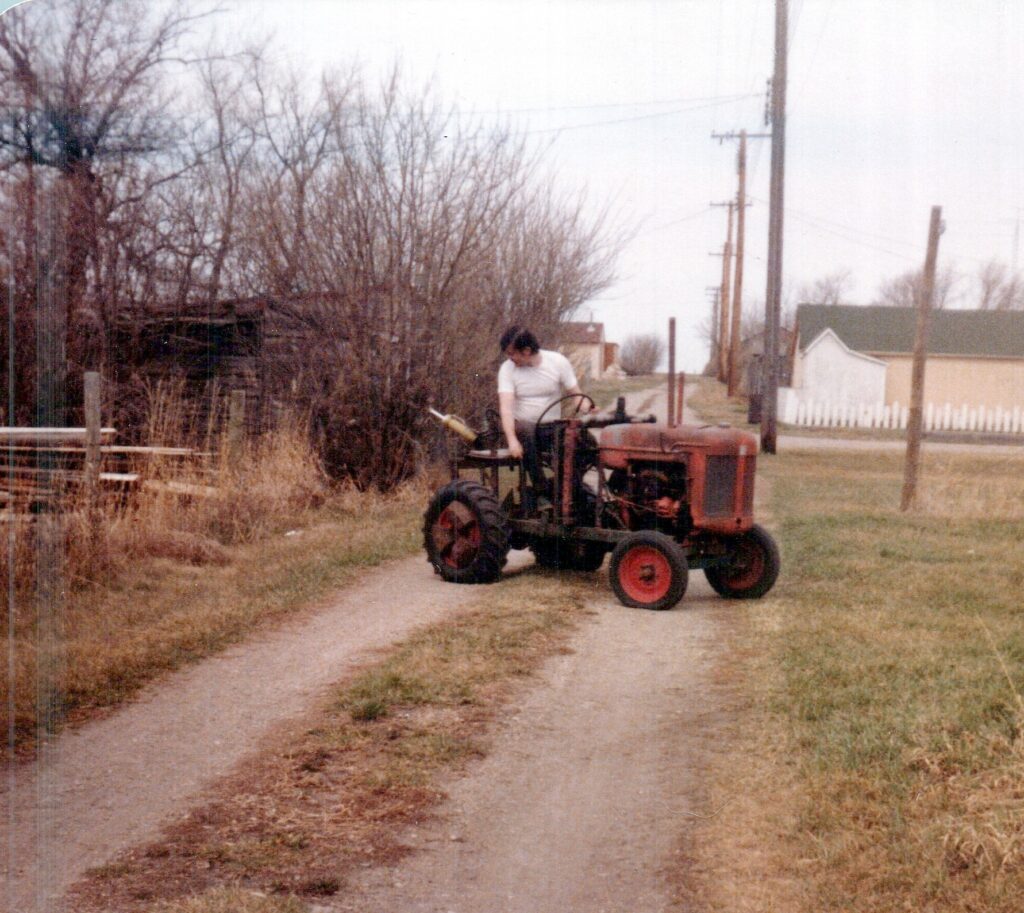
One of the best examples was his homemade garden tractor. Using an old combine motor, scrap iron, his own welder and skills he had largely taught himself, George built a working tractor from the ground up. He used it for years in the garden and for clearing snow — and eventually even built a front-end loader for it.
Buying a new part was not necessarily George’s first solution. If he could make the part himself from something he already had, that was often the better answer. For George, there was little reason to discard something that could be repaired, reused or turned into something useful.
In 1976 and 1977, he became a 4-H leader, passing some of those woodworking skills on to another generation of young people.
There Was Usually a Way
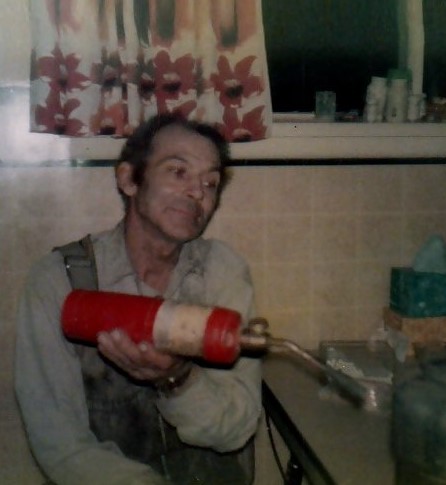
George had a practical answer for almost everything. If something broke, he repaired it. If he needed something he didn’t have, he often made it.
Even a power failure was simply another problem to solve.
During one outage, with no electricity to boil water, George improvised his own way of heating it. The family photograph captured him at work — making sure that even without power, there would still be hot water for his tea.
It was a small moment, but a very George-like one.
There was usually a way — and George usually found it.
A Family Faces Tragedy
By the early 1970s, George and Betty had raised their family and were beginning to see their children establish lives of their own. In July 1972, George and Gareth travelled to Langruth to help build a new house for their daughter Rosemarie and her husband, Bud Carriere.
While they were working on the house, tragedy struck the family. On August 5, 1972, their son Bill was killed in an automobile accident. He was only seventeen years old.
Fourteen months later, on October 7, 1973, their son David was killed in another automobile accident. David’s wife Beth and his brother Gareth were also seriously injured and spent a long time in hospital.
In little more than a year, George and Betty had lost two of their sons.
They carried those losses with them for the rest of their lives.
A Father's Helping Hands
In July 1978, George spent a month in Winnipeg helping his son Dan and daughter-in-law Judy renovate the house they had recently purchased.
There was plenty to do before the young family could move in, and George brought with him the carpentry skills he had spent a lifetime developing. He built new kitchen cupboards, helped install new carpet and trim, and tackled the many other jobs needed to turn the house into a home.
Judy worked alongside George during the day, while Dan joined them after work in the evenings.
For George, helping his children in this way came naturally. The same hands that had built houses, remodelled homes and fashioned a tractor from discarded machinery were now being put to work for his own family.
It was simply what Dad did.
The George Everyone Remembered
George was always a teacher. He enjoyed sharing what he knew, whether with the young people he later taught as a 4-H leader or with his own children growing up around him.
Dan remembers helping his father repair the family vehicles when he was a young boy. The boys would take turns holding the flashlight while George worked. Inevitably, they would point the light toward whatever they were trying to see rather than where their father needed it.
George had a familiar response:
“Who are you holding that light for?”
Providing for a growing family was not easy. For a time, George worked for the railway during the day and then worked nights and weekends for farmer Hector McInnes. Eventually he left the railway and went to work for Hector full-time.
The Shiels family lived about a mile from Hector’s farm, on land Hector had purchased from George’s father. Every day, summer and winter, George walked across the field to tend the cattle and do the day’s work. Dan still remembers his father disappearing across that field in his big winter coat, even on the coldest days of the year.
George’s ability to build and repair things sometimes seemed almost instinctive. He could visualize a project in his head, work out how the pieces needed to fit together and then build it. Houses, cupboards, machinery or repairs — there was very little that seemed beyond him.
He was also remarkably comfortable around the materials of his trade. During his carpentry years, George could even lie down on fiberglass insulation and have a nap — material that would leave most people itching simply from touching it.
Perhaps most importantly, George didn’t keep what he knew to himself. He taught. That ability to understand how things worked and then make something with his own hands continued in his sons Dan & Gareth, and again in Gareth’s son Micheal who has become a carpenter.
The skills George shared became part of the family inheritance.
A Life Cut Short
George continued working as a carpenter in the Napinka and Melita area throughout the 1970s. Building and repairing things remained a part of his life right to the end.
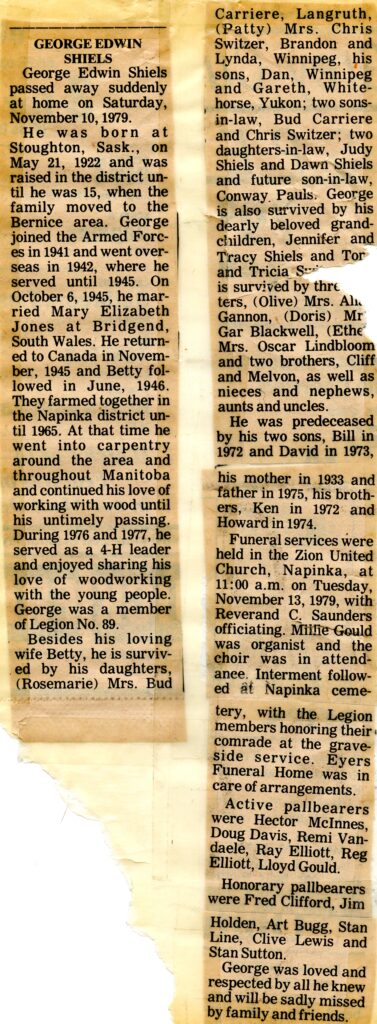
On November 10, 1979, George died suddenly at his home. He was only 57 years old.
His funeral was held three days later at Zion United Church in Napinka. Members of the Royal Canadian Legion honoured their former comrade at the graveside — a final connection to the young nineteen-year-old who had enlisted in the Canadian Army nearly four decades earlier.
George’s obituary ended with a simple statement:
“George was loved and respected by all he knew.”
Betty's Story Continued
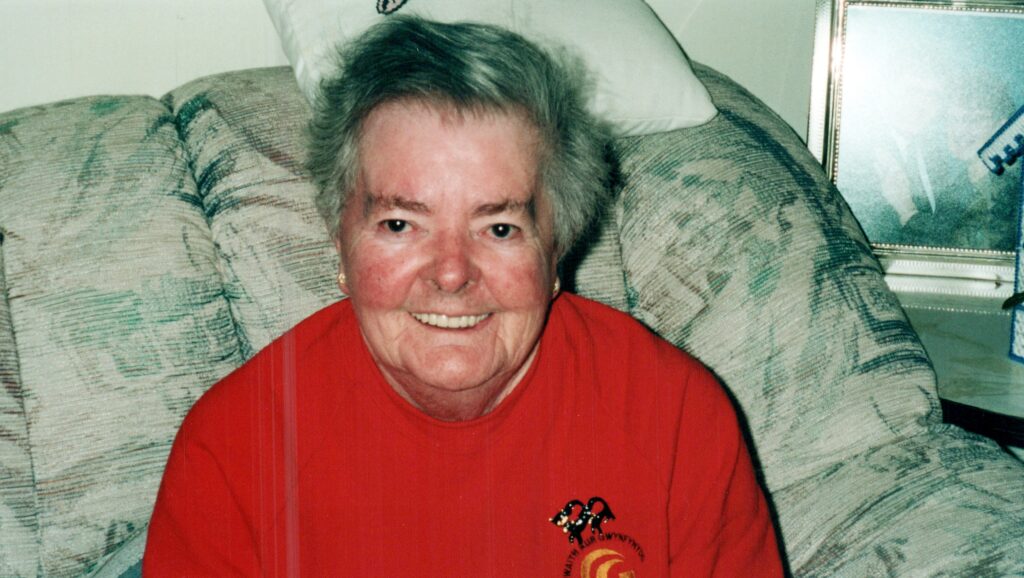
George’s death in 1979 left Betty to begin a very different chapter of her life. After more than thirty years together — from their chance meeting on a bridge in Wales, through the war, immigration, farming and raising their family in Manitoba — she now faced life without him.
Betty remained in Napinka until the spring of 1992, when she moved to Brandon. In 1995 she married Ken Heatherington, and two years later they moved to Campbell River, British Columbia.
Her later years brought health difficulties with a serious heart attack, a significant stroke and eventually another major change. In 1999 Betty returned to Winnipeg, where she lived for 18 months with her son Dan and daughter-in-law Judy. She also legally changed her name back to Shiels.
In January 2001, Betty moved to West Park Manor. She made friends there, enjoyed the activities and particularly loved the sing-songs — something that suited the outgoing Welsh girl who had crossed an ocean more than half a century earlier to begin a new life in Canada.
Betty died in Winnipeg on July 27, 2005, at the age of 83.
From Bridgend, Wales, to the Manitoba Prairies, Canada had become her home — but Wales always remained part of who she was.
The Family They Built
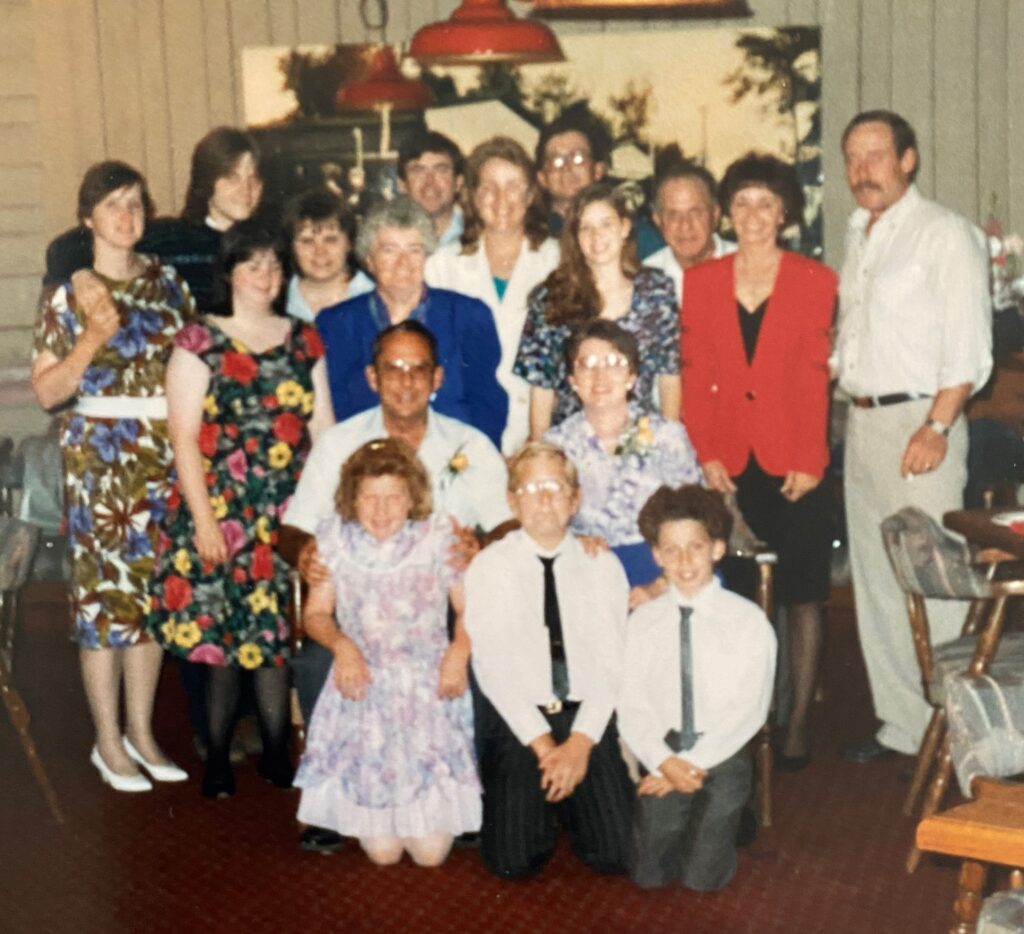
What began with the unlikely meeting of a Canadian soldier and a young Welsh woman on a bridge in Bridgend became a marriage that lasted more than thirty years and a family whose story continues today.
George and Betty raised seven children — Rosemarie, David, Dan, Patty, Bill, Gareth and Lynda. Their family knew hard work and difficult times, but also the strength that came from helping one another and simply finding a way when something needed to be done.
George left his family more than the houses, cupboards and machinery he built with his hands. He passed along his curiosity, his resourcefulness and his willingness to teach. Those skills continued through his children and grandchildren.
Betty brought something equally important across the Atlantic. She left her family and homeland as a young war bride and built a new life on the Manitoba Prairies. Through her, Wales became forever woven into the Shiels family story.
Together, George and Betty connected two very different worlds — the Shiels family of the Canadian Prairies and the Jones family of South Wales.
Their greatest legacy was the family that came after them.
The Story Continues
The story that began generations ago in Scotland has now reached the generation where family history becomes personal memory.
George and Betty’s third child, Daniel Philip Shiels, carries the direct Shiels family line forward. His story, together with that of his wife, Judith Louise Vandaele, brings the family journey into the present generation.
The Shiels family story continues with G10 — Dan and Judy.