
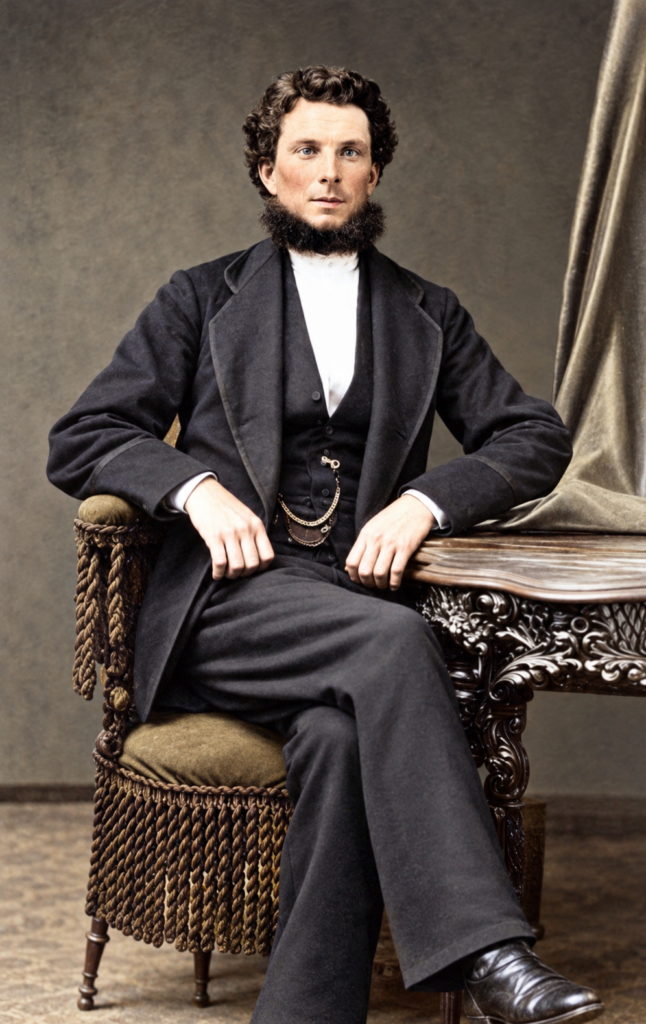
Thomas Shiels (1819-1897) & Elizabeth Prentice
Thomas Shiels was born on July 12, 1819 near Biggar, Lanarkshire, Scotland, the second child son of Thomas Shiels and Barbara Jean Cranston.
His life would take him far from his Scottish birthplace. With Elizabeth Prentice at his side, Thomas would build a family whose story stretched from Scotland to Illinois, Ontario and eventually the Dakota Territory.
Thomas & Elizabeth
As a young man, Thomas worked as a coachman and groom at Muirlea Farm, near Libberton, Scotland. The farm belonged to John Prentice, and it was there that Thomas met and fell in love with his employer’s daughter, Elizabeth.
Elizabeth came from a well-educated family, and on April 30, 1840, she and Thomas were married at Liberton, Scotland. Together they began a partnership that would endure for more than fifty years and carry them across an ocean and eventually through three countries.
Their first four children were born in Scotland: Robert Hunter, Jane, Thomas Prentice and John. By 1852, however, Thomas and Elizabeth were ready to leave Scotland behind and begin a very different chapter in their lives.
A New Life in America — 1852
In 1852, Thomas and Elizabeth left Scotland with their young family and emigrated to the United States, eventually settling near Greenup, Illinois. The journey brought tragedy almost immediately. Their youngest child, John, died during the voyage and was buried at sea.
Life in Illinois proved difficult. Thomas became seriously ill with malaria, leaving Elizabeth to support the family by teaching school and taking in sewing. Another son, William, was born in 1854 but lived for only four months.
William was buried in the private Prentice family cemetery on the farm of Elizabeth’s brother, James Prentice. Although John had been buried at sea, a marker was also placed there in his memory.
Despite these hardships, the family established roots in Illinois. Their eldest son, Robert, worked for his uncle James Prentice and would eventually marry James’s daughter, Elizabeth.
Reunited with His Brothers — 1860
In 1860, Thomas and Elizabeth made another major move, this time north to Canada. With their son Thomas Prentice, they settled in Grey Township, Ontario, within a mile of Thomas’s younger brothers, John and George, who had emigrated from Scotland ten years earlier.
Thomas purchased Lot 16 in the 15th Concession from his brother John. Their two eldest children, Robert and Jane, remained behind in Illinois, where both would marry and establish families of their own.
The Grey Township property proved to be rather poor farmland, so Thomas drew upon skills he had developed while working with horses in Scotland. He became known locally for his ability with animals and served as the area’s veterinarian. He also developed a reputation as a well driller and a “witcher,” using his skills to locate underground water.
Two more children were born while Thomas and Elizabeth lived in Ontario: Elizabeth in 1860 and another son, John, in 1862. In 1881 they also adopted James Grant, a young boy whose mother had died when he was very young.
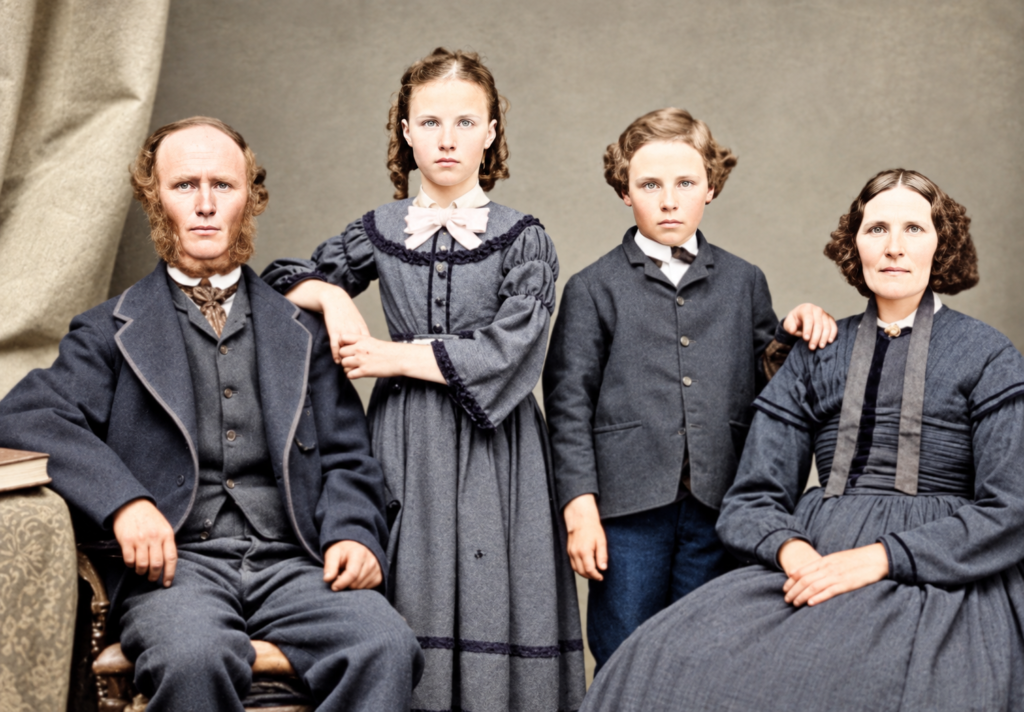
West to Dakota Territory
When their son Thomas Prentice Shiels married, Thomas gave him half of the family farm in Grey Township as a wedding present. Thomas Prentice and his wife Margaret remained there until 1881, when word of available homesteads in Dakota Territory offered the possibility of a new beginning. They packed up their family and moved west to Fort Ransom, North Dakota.
Five years later, in 1886, Thomas and Elizabeth followed. Accompanied by their younger children Elizabeth, John and James, they left Ontario and joined Thomas Prentice and his family near Fort Ransom.
Thomas and Elizabeth settled on the west side of the Sheyenne Valley and once again took up farming. After a lifetime that had begun in Scotland and carried him through Illinois and Ontario, Thomas had made one more new home on the American prairie.
In October 1892, Thomas became a citizen of the United States.
Thomas & Elizabeth — In Their Own Way
Elizabeth was remembered as a woman of strong character and deep Presbyterian faith. Even in later life, she retained her strong Scottish accent and was said to have a fine head of black hair with hardly any grey. When she went out she wore a small bonnet, and around the yard and garden she wore a sunbonnet.
Sundays in the Shiels household were observed strictly. Meals were prepared the day before, the Bible was the only permitted reading, and everyone was expected to spend the Sabbath quietly. No unnecessary work was allowed — not even cooking a meal.
Thomas, however, had a small act of rebellion of his own. The newspaper arrived only once a week, and on Sundays he would slip over to his son’s home to read it. Despite Elizabeth’s best efforts, she was never able to break him of what she considered his “terrible” habit.
It is a small story, but one that gives us a wonderful glimpse of this couple: Elizabeth, determined and unwavering in her beliefs, and Thomas, apparently just as determined to enjoy his Sunday newspaper.
The Shiels Family “Shoot-Out”
Life on the frontier occasionally brought disagreements, and one incident involving Thomas came about over something as simple as a fence line.
Thomas and a neighbour named Barch became involved in an argument, during which Barch struck Thomas on the head with a heavy stick. Bleeding badly, Thomas made his way home, where Elizabeth patched him up. By then several neighbours had gathered, and their anger over what had happened only added to Thomas’s own.
Thomas took his muzzle-loading shotgun from the wall, loaded it, and prepared to join the neighbours in going after Barch. As he passed through the kitchen, however, the gun struck something and accidentally discharged. The shot grazed Thomas on the head, producing still more blood — and sending him back to Elizabeth for a second round of repairs.
Thomas carried the scar for the rest of his life. Fortunately, the incident ended there, remembered in the family as perhaps the closest the Shielses ever came to having a feud — or a shoot-out.
Remembering Elizabeth
Elizabeth died in 1891 at the age of 76. After more than fifty years of marriage and a life that had carried them from Scotland to Illinois, Ontario and North Dakota, Thomas was left without the woman who had shared almost his entire adult life.
After her death, Thomas lived for a time in a small home in the valley. He never put Elizabeth’s belongings away. Her things remained where she had left them, even her familiar sunbonnet still hanging on the wall.
It is a simple detail, but perhaps one of the most revealing in their story. Beneath the colourful stories and Thomas’s independent nature was a man who clearly felt the loss of the woman who had been beside him for more than half a century.
Thomas later moved to Englevale, where he lived with his youngest daughter, Elizabeth, and her husband, James Tracy Logan.
The Unexpected Midwife
While Thomas was living with his daughter Elizabeth and her husband, James Tracy Logan, another incident revealed just how capable and resourceful he remained in his later years.
Elizabeth was expecting her fourth child when the time came for the baby to be born. James hurried away to fetch a neighbour woman to assist with the delivery, but the baby had other plans. Events moved much faster than anyone expected.
With no help available, Thomas simply took charge. He went into the bedroom with his daughter, closed the door and delivered his granddaughter himself. Using his pocketknife, he cut and tied the umbilical cord, wrapped the newborn in a blanket and had her safely settled by the time help arrived.
For a man who had once worked as a groom, became a farmer, local veterinarian, well driller and water “witcher,” perhaps delivering a baby was simply one more problem that needed solving.
Thomas Shiels died at Englevale on May 31, 1897. He was 77 years old.
His life had begun near Biggar, Scotland, and ended on the North Dakota prairie nearly eight decades later. Between those two places lay an extraordinary journey through Scotland, Illinois, Ontario and Dakota Territory — and a family whose descendants would continue the Shiels story across North America.
The Shiels Name Becomes Shields
One of Thomas and Elizabeth’s younger sons, John Prentice “Ab” Shiels, eventually carried another branch of the family west to North Dakota. After settling near Velva and later moving to Minot, John encountered a problem familiar to many members of the family — people continually spelled Shiels with a “d.”
John finally solved the problem permanently. He legally changed his surname from Shiels to Shields, and his descendants carried the new spelling forward.
John’s son Thomas Jacob Shields became a firefighter in Minot. In 1909 he was critically injured while fighting a fire at the Minot Daily Optic newspaper building and later died from his injuries. He is remembered as the first Minot firefighter to lose his life in the line of duty.
It is an unusual little branch of the family story: a Shiels became a Shields, and within the next generation that new name became part of the history of Minot, North Dakota.
Their Family
Across their years in Scotland, Illinois and Ontario, Thomas and Elizabeth raised a family whose own lives reflected the movement of the Shiels family across North America.
They had seven biological children — Robert Hunter, Jane, Thomas Prentice, John, William, Elizabeth and a second son named John — and later adopted James Grant. Two of their sons died young: John during the family’s voyage from Scotland in 1852, and William in infancy in Illinois.
Their surviving children established families of their own, and in the generations that followed their descendants spread across much of the United States and Canada. What began with one Scottish family would eventually grow into numerous branches stretching across the continent.
The Story Continues
Among Thomas and Elizabeth’s children was their son Thomas Prentice Shiels, born in Scotland in 1845. As a young boy he crossed the Atlantic with his family, later followed them to Canada, and eventually continued the family’s westward journey to Dakota Territory.
It is through Thomas Prentice that we will follow this branch of the Shiels family — a line that eventually leads to Sigurlaug “Ruby” Shiels, whose contribution helped preserve much of the history presented here.