
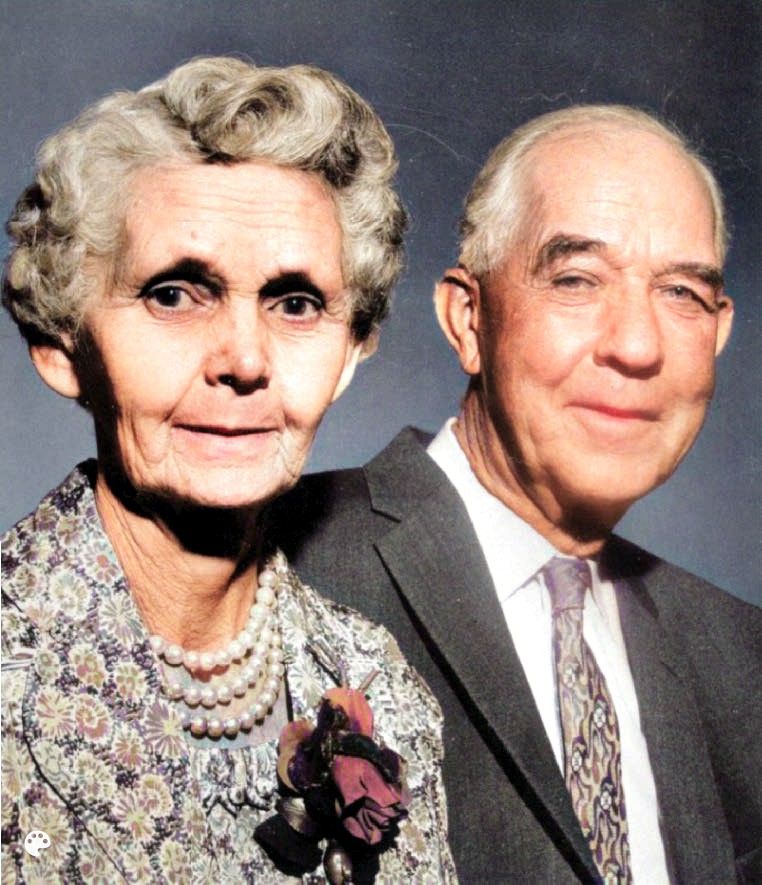
George Robert Shiels (1886–1962) & Rosa Stefansson
George Robert Shiels was born on March 5, 1886, in a sod house overlooking the Sheyenne Valley near Fort Ransom, Dakota Territory. He was the eighth of nine children born to Thomas Prentice Shiels and Margaret Avery.
With curly red hair and bright blue eyes, George grew up on the open prairie beside the Sheyenne River. His childhood included one-room schools, fishing, swimming, homemade rafts and the freedom of prairie life — but it was also marked by the loss of his father when George was only five years old.
His life would eventually take him north to Saskatchewan and then east to Manitoba. Along the way he would meet Rosa Stefansson, beginning a marriage that would last more than fifty years and lead this branch of the family to one of the important keepers of its history — their daughter Ruby.
From Fort Ransom to Saskatchewan
After the death of his father in 1892, George’s mother, Margaret, kept the Fort Ransom farm operating with the help of her oldest son, Bert. She later had a house built in town so the younger children could attend school more easily.
By the early 1900s, the promise of free homestead land was drawing settlers north into western Canada. Bert travelled to the Long Lake district north of Regina and selected homesteads for himself and his mother. In 1905, Margaret followed with Art, George and Clara, beginning another chapter in the family’s westward journey.
Near Craven, Saskatchewan, Margaret, Bert and George each took up a quarter-section of land. George was nineteen years old and, for the first time, had land of his own.
Farming, however, would not prove to be George’s future. He sold his homestead and took up barbering in the little town of Craven. And it was there, in the spring of 1909, that a casually thrown snowball would change the course of his life.
A Snowball — and Rosa
By the spring of 1909, George was working as a barber in the little town of Craven. One day, George and some of the other young men around the barbershop were outside fooling around and throwing snowballs at one another.
George let one fly just as a young woman he had never seen before came around the corner. The wet, slushy snowball struck her.
George, with his unmistakable red hair — and apparently an equally noticeable ability to blush — hurried over to apologize while his friends added to his embarrassment with their laughter and catcalls. Fortunately for George, the young woman accepted his apology. Her name was Rosa Stefansson.
Rosa had come to the Craven area because her father, William Ward, was an engineer with the Dominion Government. A dredge, tugboat and crew had been brought west from Manitoba for work connected with Valeport and Last Mountain Lake, and William’s wife and children accompanied him.
What began with an accidental snowball soon became something much more important. Within months, Rosa had accepted George’s ring, and on April 30, 1910, George Robert Shiels and Rosa Stefansson were married in Lumsden, Saskatchewan.
It was the beginning of a marriage that would last more than fifty years — although it must surely rank among the more unusual introductions in the Shiels family story.
From Saskatchewan to Manitoba
Not long after their marriage, George and Rosa left Saskatchewan and moved east to Selkirk, Manitoba, where George found work with the Dominion Government.
His work was remarkably varied. George was involved with dredge operations and the repair and maintenance of boats and equipment. He earned his second-class stationary engineer’s papers and also worked on the construction of the Lockport bridge and locks.
Perhaps the most unusual part of his work was underwater diving. Wearing a heavy rubber diving suit with weighted equipment and an iron helmet, George worked beneath the surface on projects connected with the dredging operations. He also worked with teams of horses used to scoop and move earth during the Lockport construction.
George and Rosa made their home in a cottage on Greenwood Avenue in Selkirk, and it was there that their young family began to grow. Mildred was born in 1910, followed by Kelly in 1912, Fred in 1914, Norma in 1916 and Sigurlaug “Ruby” in 1917.
For George, the move to Manitoba had taken him far from the sod house and prairie farm of his childhood. He had become a husband, father, engineer and even an underwater diver — but Saskatchewan had not seen the last of the Shiels family.
Back to Saskatchewan
In 1918, George received a letter from his older brother Bert, asking him to return to Saskatchewan and help with the family farm. Bert had never married and needed someone to help with the household as well as the farming operation.
George and Rosa decided to make the move. They left Selkirk with their five young children and returned to the Craven area, where George once again took up farming alongside his brother. Two more children were added to the family after their return: Bob in 1919 and Billy in 1922, bringing George and Rosa’s family to seven children.
Farm life was demanding, particularly on the open Saskatchewan prairie. George’s fair complexion and red-haired Scottish ancestry were not especially well suited to long days under the prairie sun, and he increasingly found that his real interest was in livestock rather than grain farming. He loved animals and would have preferred to operate a stock farm.
But life was not all work. George took an active part in the community and loved sports. He was a baseball pitcher, and family life included outings, dances and picnics whenever time and circumstances allowed.
Money was often scarce and prairie life could be hard, but the memories that survived were not simply of hardship. They were also memories of a close family, humour, neighbours and the enjoyment George and Rosa managed to create for their children.
A Home Filled with Family
George and Rosa worked hard, but family memories suggest that their home was never defined simply by the hardships of prairie life. With seven children growing up around them, there was always activity — and somehow there was room for laughter and fun as well.
George enjoyed people and community life. Baseball games, dances, picnics and family outings provided welcome breaks from the demands of the farm. He loved animals and particularly enjoyed working with livestock, interests that helped make farm life more than simply a means of earning a living.
Rosa brought her own distinctive character to the family. Of Icelandic heritage, she retained traces of her Icelandic accent throughout her life. Together, she and George created what their children remembered as a snug and secure home, even during years when money was scarce.
Their marriage had begun with an accidental snowball in Craven, but the affection between George and Rosa endured through more than half a century together. Their family would experience both happiness and heartbreaking loss, yet the memories that remained were filled with humour, warmth and a strong sense of being loved.
Heartbreak in the Family
As the years passed, George and Rosa watched their children grow into adulthood and begin lives of their own. But the close family they had worked so hard to build would eventually experience two devastating losses.
Their youngest son, Billy, served during the Second World War and later attended university. While working in Flin Flon, Manitoba, he drowned at only 26 years of age. His death was remembered as the first break in the family circle, and the loss was particularly difficult for George and Rosa.
Only two years later, tragedy struck again when their eldest daughter, Mildred, died in Sudbury, Ontario. Within a very short period, George and Rosa had lost two of their seven children.
These were painful years, but the family memories of George and Rosa are not dominated by tragedy. Instead, they speak of the love, humour and security that had always surrounded their children — qualities that helped the family carry on even through its most difficult times.
Later Years Together
In 1951, after many years of farming and raising their family, George retired. He and Rosa moved to Winnipeg, where George took a position as caretaker at St. Paul’s United Church. Their daughters Ruby and Jean were living with them during these years, and the family remained close.
In 1959, George and Rosa moved once more, this time to the suburbs of Winnipeg. The following year they celebrated a very special milestone — their Golden Wedding Anniversary, marking fifty years since the red-haired young barber’s badly aimed snowball had introduced him to Rosa in Craven.
George died suddenly on February 5, 1962, at the age of 75. Rosa lived for another eight years, passing away on February 12, 1970. They were buried together in Kildonan Presbyterian Cemetery in Winnipeg.
Their life together had carried them through Saskatchewan and Manitoba, through farming, government work, raising seven children and the heartbreak of losing two of them. There had been difficult years and times when money was scarce, but the family remembered something more important — a home filled with love, humour and a sense of security.
From that chance encounter with a snowball in 1909 came a marriage lasting more than half a century and a family whose stories would continue to be remembered long after George and Rosa were gone.
Their Family
George and Rosa raised seven children: Mildred (1910), Kelly (1912), Fred (1914), Norma (1916), Sigurlaug “Ruby” (1917), Bob (1919) and Billy (1922). The first five were born during the family’s years in Selkirk, Manitoba, while Bob and Billy arrived after the family returned to Saskatchewan.
As the children grew, their lives took them in different directions, but the close family ties established by George and Rosa remained an important part of their story.
For our journey through this branch of the Shiels family, however, we will follow their fifth child, Sigurlaug “Ruby” Shiels.
Ruby never married or had children of her own, but she played a particularly important role in preserving the history of this branch. Her memories and contributions became part of the family record we are using today — giving future generations something far more valuable than simply names and dates.
The Story Continues
Among George and Rosa’s seven children was Sigurlaug “Ruby” Shiels, born in Selkirk, Manitoba, on September 23, 1917.
Ruby never married, but family remained an important part of her life. She lived with her parents until their deaths and later shared a home with her sister Jean. Over the years she worked in Winnipeg, spent summers aboard the passenger ship S.S. Kenora on Lake Winnipeg, and eventually retired to a cabin at Winnipeg Beach — a place she simply called “The Beach.”
But Ruby’s importance to this story goes beyond the events of her own life. She took an active interest in preserving her family’s memories and became a major source of information for the history of this branch of the Shiels family. The original family history records simply and warmly that “Ruby was a great help in preparing this part of the history.”
It seems fitting, therefore, that our journey through this branch should end with Ruby. The story began generations earlier in Scotland, travelled through Ontario and Dakota Territory, and returned to Canada through Saskatchewan and Manitoba.
Ruby helped make certain that the stories from that journey were not lost.