
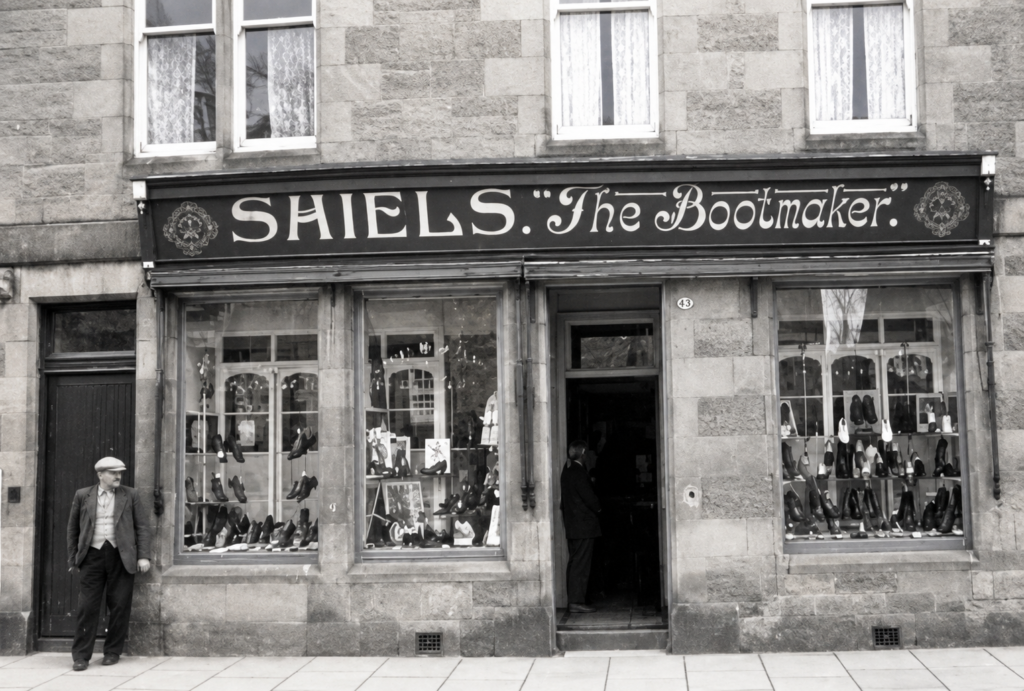
George “The Bootmaker” Shiels (1865–1936) & Margaret McMorran
George Shiels was born on July 25, 1865, the sixth child of William James Shiels and Agnes Brown. With four generations of the family sharing the name George Shiels, and none having a middle name, he became known within the family as “George the Bootmaker.”
The Bootmaker
George apprenticed as a bootmaker and spent his working life alongside his older brother Thomas, who owned “Shiels The Bootmaker” in Biggar. George developed a fine reputation throughout the district for the quality of the boots and shoes he made.
Biggar was an important gathering place for the surrounding farming community, particularly on livestock sale days when farmers and their families came into town. Those busy days would have brought many potential customers past the Shiels shop and its distinctive storefront.
A Familiar Face Around Biggar
Away from the workbench, George was an avid reader with a particular interest in the poetry of Robert Burns. In retirement, he became a familiar figure walking around Biggar, always ready to stop and talk with those he met.
George seems to have had an easy way with people from all walks of life. When travelling Gypsies came through the area, he would stop to visit with them and became friendly with members of their community. It is a small detail, but one that provides a glimpse of the sociable and curious man behind the name “George the Bootmaker.”
George & Margaret
On June 27, 1890, George married Margaret McMorran in Libberton, Scotland. Together they raised seven children while George continued his trade as a bootmaker in Biggar.
Their family began with William, born in 1890, followed by Mary “Moll” in 1892, Robert McMorran in 1893, Agnes in 1896, David in 1899, John in 1903 and George in 1906.
The Family Continues
George and Margaret raised a family whose lives remained closely connected with Biggar, Coulter and the family bootmaking business. Several of their children worked in the shop, while others followed very different paths. Together, their stories provide a fascinating glimpse of how one generation of the Shiels family moved from a traditional family trade into the changing world of the twentieth century.
William — The Next Generation of Bootmaker
William Shiels, the eldest child of George and Margaret, followed his father into the family trade. After serving in the First World War, he returned home and married Isabella Campbell on December 29, 1916. They had two children, Isabella Gibb “Bell” and George.
William worked in the “Back Shop,” making and repairing footwear for farmers, farm workers and herdsmen. The heavy work boots had turned-up toes and almost solid soles, while leather leggings were shaped to fit the calf. Much of the work was done by hand. Sewing thread was repeatedly drawn through pitch, leaving William’s hands permanently blackened and deeply marked by years of working with the thread and sharp knives. Leather was even seasoned in a bathtub outside the workshop.
His skills extended well beyond ordinary footwear. William became known for making specialized shoes for people with disabilities, and a hospital in Edinburgh sent orders to him for specially made footwear—a remarkable indication of the reputation his craftsmanship had earned.
Mary “Moll” — The Front Shop
Mary “Moll” Shiels, the second child of George and Margaret, chose a very different role in the family business. At only eighteen, she faced a choice between marriage and remaining in the shoe business. Moll chose the business, never married, and eventually inherited Shiels The Bootmaker from her uncle Thomas when he died in 1924.
While William worked in the “Back Shop,” Moll became the familiar face of the “Front Shop,” serving customers and keeping the books. She was remembered for her easy manner with people and her ability to wrap a shoebox in brown paper, tie it with the shop’s printed string and carry on a conversation about the events of the day—all at the same time. She was also remembered as the first woman in Biggar to own a bicycle.
By the late 1950s, times were changing. Bob was gone, William was getting older, and factory-made footwear was replacing the traditional work of the bootmaker. Moll had little regard for the new fashions, referring to some of them as “rubbish” that she would not stock. Eventually she closed the shop, bringing an end to a family business that had been part of Biggar for generations
Robert “Bob” & Agnes — Family at the Heart of the Shop
Robert McMorran “Bob” Shiels, the third child of George and Margaret, was unable to serve in the First World War because of poor health and instead worked in the steelworks in support of the war effort. After being injured there, he returned to the family bootmaking business, where he kept the accounts and also worked in the “Back Shop.”
Bob never married, but family remained an important part of his life. He was remembered as having “a heart of gold,” with interests in gardening and art. Perhaps most telling was his relationship with the children of the family—he would take them to the bookstore and buy each of them a book, encouraging in another generation the love of reading that appears so often in this branch of the Shiels family.
Agnes Shiels, the fourth child, also never married. She became the family housekeeper and helped in the Front Shop whenever things became busy. From the small galley kitchen in the Biggar house she prepared the family meals, yet she was remembered as always finding time to have something special for the children. Later, Agnes and Moll lived together in Gladstone Cottage, directly across the road from the old bootmaking business.
David — A Life Beyond the Boot Shop
David Shiels, the sixth child of George and Margaret, hoped as a young man to become a carpenter. With neither room at home for him to stay nor money available for an apprenticeship, that opportunity was not possible. Instead, he began working and living on farms throughout the district.
David’s working life took many turns. He served with the Scottish Rifles during the First World War, including service in Ireland and France, and later worked in the timber industry, coal mines and again on farms. Because housing was often tied to employment, David and his family moved frequently. Eventually he found more settled work with the County Council, maintaining the country back roads.
David married Jane “Jean” Bell Tennent in September 1924. They had four children: Agnes “Nessie,” Jean “Bunty,” Margaret and George. Sadly, Margaret died in 1934 at only two years of age.
A quiet man with strong Presbyterian beliefs, David enjoyed music, Scottish set dancing and reading. In retirement, when improved health allowed, he could still be found helping friends by cutting the long grass in their gardens with a scythe—simply for the pleasure of doing it.
John — A Short Life
John Shiels, the fifth child of George and Margaret, was born in 1903. Sadly, his life was very short; he died the following year and was buried at Coulter.
George “Dodd” — From Biggar to the Classroom
George “Dodd” Shiels, the youngest of George and Margaret’s seven children, was born on April 10, 1906 at Townfoot, Coulter. While several of his siblings became closely involved with the family bootmaking business, Dodd followed a very different path.
He attended Glasgow University, graduating with an MA with honours, and began his career as a schoolteacher in the Glasgow suburbs. He later became Headmaster of Braehead Village School before moving on to the larger Carnwath Village School. Dodd was remembered as a man who took a genuine interest in his students and was always willing to talk with them.
Dodd married Peggy Rodger in Glasgow on July 7, 1932, and they had two children, Meryl and George. Like his father, Dodd had a keen interest in Robert Burns and became known for his renditions at Burns Suppers. He was respected not only for his scholarship, but also for his ability to relate easily to people from all walks of life.
Helping Preserve the Family Story
Meryl Shiels, daughter of George “Dodd” and Peggy, played an important part in preserving the history of this branch of the Shiels family. Over the years, she provided information and memories that helped bring together many of the details recorded in these family stories.
Meryl pursued her own successful career in personnel management in Glasgow, returning to work after raising her family and continuing until her retirement in 1992. More importantly for this history, she generously shared what she knew about earlier generations of the family. Much of what we know about George the Bootmaker, his children and life around the Biggar shop has been enriched by family memories such as hers.
East Mains & Gladstone Cottage
The family’s connection with East Mains continued into another generation. When Margaret Thomson died in 1947, East Mains was left in equal shares to Moll, Agnes and Bob. Moll later purchased her brother and sister’s shares and became its sole owner. For many years the old family home stood largely empty and was used as a summer cottage before Moll eventually passed it to her nephew George Shiels and his family.
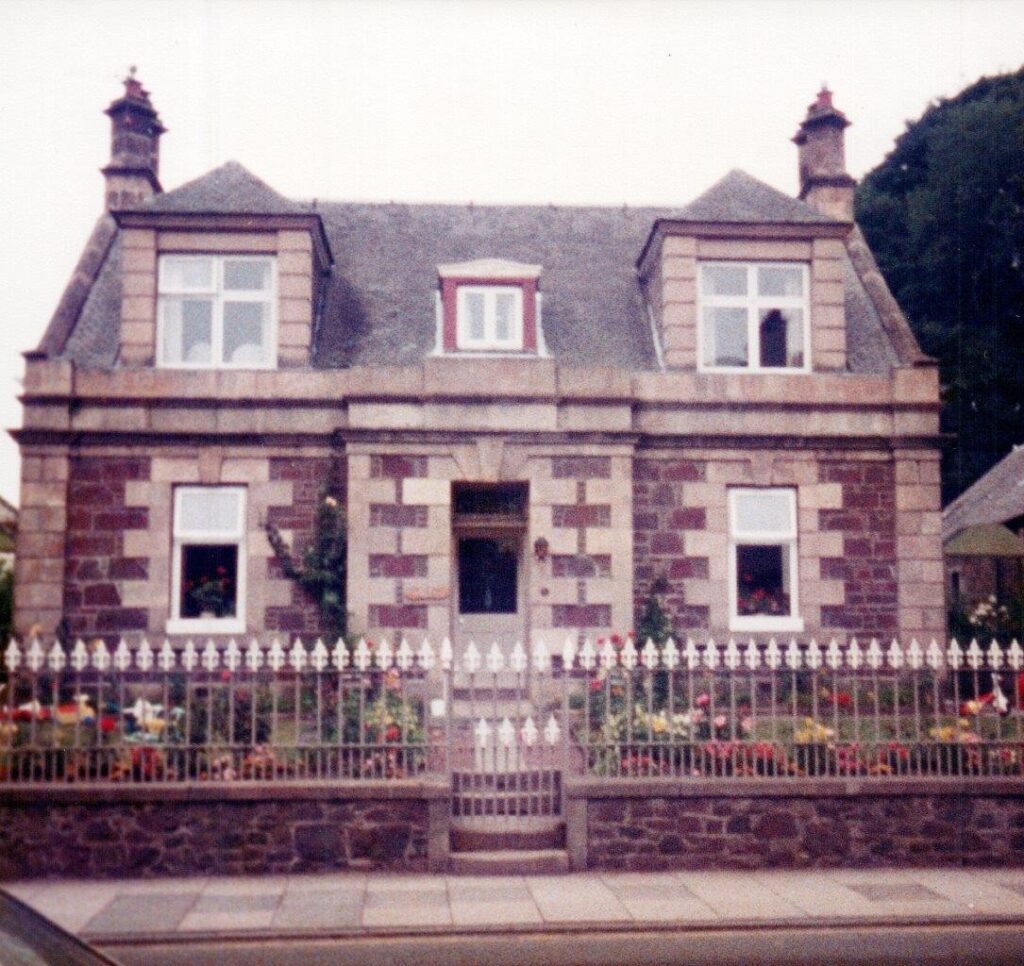
There was another house that had caught Moll’s eye much earlier. As a young woman working for her uncle Thomas, she would look across the street from the boot shop at Gladstone Cottage and say, “I am going to own that house one day.”
She eventually did.
After the bootmaking business closed, Moll and Agnes moved into Gladstone Cottage and spent the remainder of their lives there—directly across the street from the shop that had played such an important part in their family’s lives
The Story Continues
George and Margaret’s family remained closely connected to the communities of Biggar and Coulter, but their seven children followed very different paths. Some continued the family bootmaking tradition, while others found their place in farming, industry, education and family life.
For another generation, Shiels The Bootmaker remained at the centre of the family. William carried on the traditional craft in the Back Shop, while Moll, Bob and Agnes each played their part in the business and family household. Eventually the changing times brought the old shop to an end, but not the family stories that had grown around it.
Those stories were remembered and passed down by later generations, including Meryl Shiels, whose help in recording family memories preserved details that might otherwise have disappeared.
From the boot shop in Biggar to East Mains and Gladstone Cottage across the street, this branch of the Shiels family remained closely tied to the places where generations before them had lived and worked.