
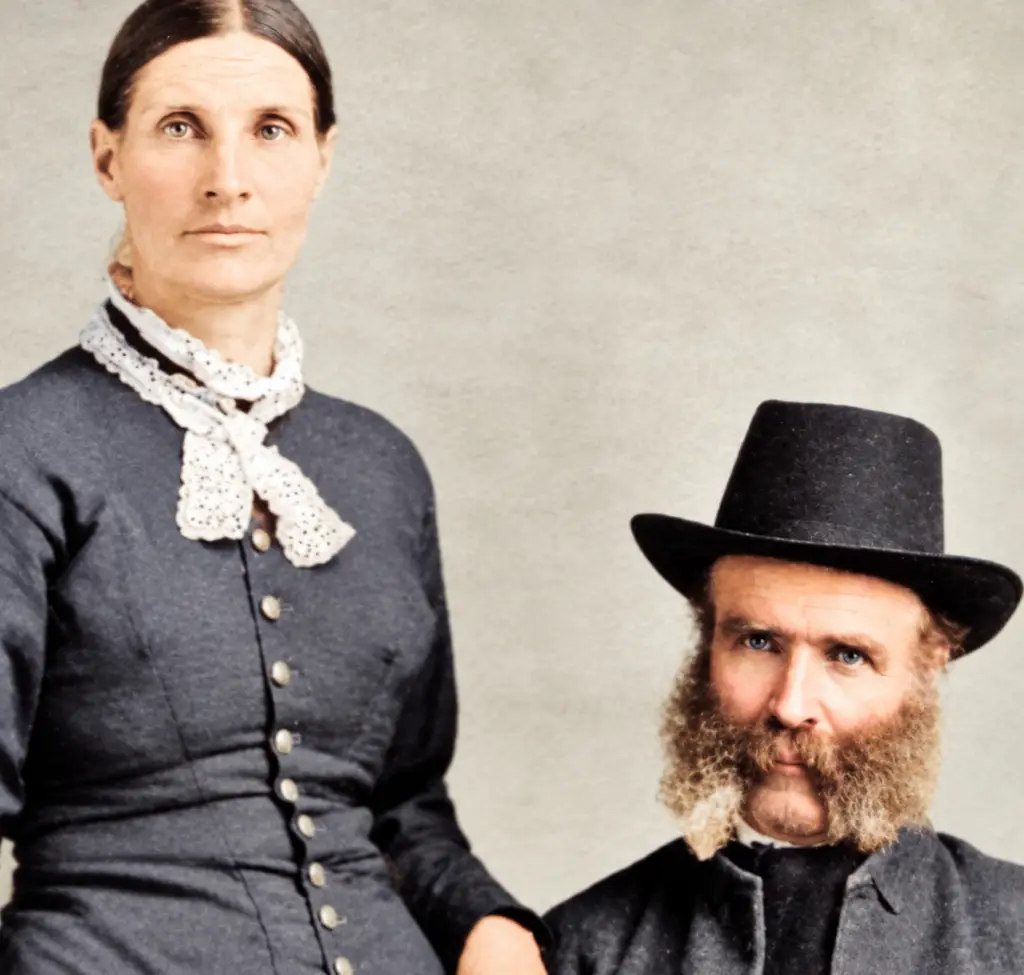
George Shiels (1828–1906) & Susannah Wortley
George Shiels was born on October 18, 1828, at East Mains near Coulter, Scotland, the fifth child of Thomas Shiels and Barbara Cranston.
In 1850, at the age of 21, George and his older brother John Shiels left Scotland together to begin a new life in Canada. Their journey aboard the Morton nearly ended in disaster, but both brothers survived and eventually made their way to the wilderness of Grey Township, Ontario.
There the brothers settled beside one another, cleared their land and established neighbouring farms. They would remain neighbours for the rest of their lives, each raising a large family whose descendants would eventually spread far beyond that small corner of Ontario.
We have already followed John’s branch of the family. Now we return to the brother who shared so much of that journey with him — George Shiels — and follow his family through his daughter Ellen, and eventually to William George “Bill” Ford, one of the people who helped preserve the history of the Shiels family.
Growing Up at East Mains
George grew up at East Mains, the family home near Coulter, Scotland. He attended the school on the estate of the Duke of Buccleuch until the age of eleven, when his formal education ended and he went to work as a choreboy on the farm of Thomas Anderson, where his older brother John was already employed.
George soon advanced to the position of plowman and became highly skilled at the work. But apparently farming was not his only talent. As a teenager, George developed a reputation as an expert checker player.
Family tradition tells of George playing a remarkable match against the world champion. The contest reportedly lasted some thirty hours, with breaks for food and sleep. Five games were played, and the young George managed to win two of them.
George later joked that losing the contest was probably the best thing that could have happened to him. Had he won, his life might have taken a very different direction. Instead, farming became his future — an occupation that would eventually carry him across the Atlantic and into the forests of pioneer Ontario.
Before leaving Scotland, George moved from the Anderson farm to a better-paying job in a greenhouse. He remained there until 1850, when he and John made the decision that would change both of their lives:
The two brothers would emigrate to Canada
The Voyage of the Morton
In June 1850, George and his older brother John left Glasgow aboard the Morton, bound for a new life in Canada. What should have been an adventurous beginning very nearly ended in tragedy.
Off the coast of Newfoundland, a sudden squall struck the ship, carrying away two of its masts and two sailors. Repairs took about two weeks, and while the ship was delayed, smallpox broke out aboard the vessel. Eleven passengers died, and John became seriously ill.
Both brothers survived the voyage and eventually landed in Canada. They stopped first at Whitby, Ontario, where a friend, Andrew Archibald, helped them find work. John, still weak from smallpox, was given lighter employment, while George found work as a teamster at a sawmill. George later remembered that he had never seen such a sensible team of horses as the ones he drove there.
George remained in Whitby for about two years before joining John again. The brothers eventually travelled west to Andrew Archibald’s farm near present-day Seaforth. From there, Archibald encouraged them to look north toward the largely unsettled Crown lands of Grey Township.
So the two young Scots set out once more — this time on foot into the Ontario wilderness, looking for land on which they could build their futures.
Into the Ontario Wilderness
George and John travelled north and then east into Grey Township. Near what is now Walton, they stopped at the Combs home for what would be their last prepared meal for some time. Farther along they reached the farm of Jim Douglas, where they were given a welcome meal of potatoes and venison. George remembered Mrs. Douglas kindly for that meal for the rest of his life.
Beyond that point, the brothers largely lived off the land. George was a good shot with their old musket, while John proved to be the better cook. They continued east along the 15th Concession, even crossing Beauchamp Creek on a log, until they reached the edge of settlement.
There, George and John selected land and built a small shanty. Together they began the enormous task of cutting down the forest and clearing fields for farming. During the summers they worked on construction of the Huron Road to earn cash for necessities; during the winters they worked side by side clearing their own land.
What began as two brothers sharing a rough pioneer shanty became two neighbouring farms. George and John would remain neighbours for the rest of their lives, raising their families beside one another in the community they had helped create.
George’s farm was sold to John Lamport in 1906 following George’s death.
George & Susannah
By 1857, George had spent several years transforming his piece of the Grey Township wilderness into a farm. That year brought another major change to his life.
On September 4, 1857, George married Susannah Wortley, daughter of Benjamin and Mary Wortley, who had come to Canada from England. The ceremony took place in Fullarton Township, Perth County, and was performed by the Rev. James Findlay. Susannah’s brother John and sister Elizabeth witnessed the marriage.
George and Susannah began their married life in a log house on the farm. In time, the rough pioneer homestead developed into an established family farm, and during the 1880s George and his sons built a large two-storey house to replace the original log home.
Their family grew rapidly. Over the years George and Susannah would have eleven children, filling the farm with another generation of Shielses and creating a much larger network of descendants than George could possibly have imagined when he first entered Grey Township with John.
The Bear and the Pig
In the early years of their marriage, George and Susannah had very little. Family tradition tells that when their first child was still a baby, George owned just one pig, which he kept in a log pen near the house.
One night George heard the pig squealing and went outside to investigate. He discovered that a bear had climbed into the pen and was after the pig.
George didn’t own a gun at the time, so he grabbed what he did have — an axe.
Susannah arrived in time to witness what happened next. George entered the pen and killed the bear with the axe, saving the family’s pig.
The old family account ends the story with a wonderfully simple observation:
Apparently, no bear was going to get George Shiels’s pig!
Building a Community
As the wilderness around the Shiels farm gradually became a settled community, George took an active role in making it a better place for the families who now called Grey Township home.
In 1864, George helped organize the local school district and was instrumental in having the first school built. He served on the school board for many years, beginning a connection between the Shiels family and the little country school that would continue through several generations.
The location could hardly have been more convenient for George and Susannah. Their children had only about 100 yards to walk to school — leading the old family history to jokingly observe that, of course, George had no self-interest whatsoever in its location!
When a new frame school was eventually constructed, George bought the old school building for six dollars and later sold it at a profit. His brother Thomas helped with the new school by digging the well and lining it with brick. Over the years, several members of the Shiels family would serve on the school board.
George had arrived in Grey Township as a young immigrant sleeping in a pioneer shanty and clearing trees from the wilderness. Within little more than a decade, he was helping build the institutions that would serve the next generation.
The wilderness was becoming home.
Susannah's Accident
By the late 1880s, George and Susannah had spent thirty years building their farm and raising their large family. Then, in 1887, an accident changed their lives.
Susannah was kicked by a cow and seriously injured. The nearest doctor was in Brussels, about nine miles away, and someone had to reach him quickly.
The family owned a driving horse named Rose, but she had a reputation for being so difficult that only the men of the family could handle her. One of George and Susannah’s sons hitched Rose to the buggy and set off for Brussels.
With the whip urging her on, Rose covered the nine miles to Brussels in about an hour. The son then returned with the doctor — two men in the buggy this time — over the same dirt roads. For the time and conditions, the family history remembered it as a remarkable journey.
Sadly, despite their efforts, Susannah never fully recovered from her injuries. She died in 1889, only 51 years old.
George lived for another seventeen years, remaining in the community where he and John had begun their lives as pioneers more than half a century earlier. He died on January 19, 1906, at the age of 77.
George and Susannah were buried in Brussels Cemetery, about eight miles from Cranbrook, where George’s brother John and John’s family would be laid to rest.
What a Difference one Initial Makes
Thomas Shiels was the 3rd child of George & Susannah. In 1880, there were four men named Thomas Shiels in the area. Thomas was apparently courting his cousin Jessie Anderson who lived in Turnberry Twp. Thomas’ mail including letters from Jessie, could easily fall into the hands of his cousins or his uncle with the same name. To avoid confusion, Thomas decided to use the middle initial “E” and was known as Thomas E Shiels thereafter, although the initial had no meaning.
Their Family
George and Susannah raised a large family of eleven children, all born during their years in Grey Township: Barbara (1859), Jane (1860), Thomas (1862), Susannah (1864), Robert (1867), Mary (1869), George (1871), Jemima (1874), Ellen (1877), William John (1880) and David (1883).
- Barbara Shiels (1859-1902) & Thomas Gilpin
Barbara Shiels was born in 1859 in Brussels, Ontario. She married Thomas Gilpin in 1878. They lived on a farm their entire life and raised six children.
- Jane Shiels (1860-1908) & William Pomeroy Bray
Jane Shiels was born in 1860 in Brussels, Ontario. She attended the school located on the farm adjoining the Shiels homestead, later called Grey Twp #8. She married William Pomeroy Bray in 1879. They lived on a farm their entire life and had nine children. Trajectly, three of their children died quite young.
- Thomas E. Shiels (1862-1936) & Jessie Anderson & Frances Mary Combs
Thomas E. Shiels was born in 1862. Thomas was a man of many talents. He and his brothers apparently built the large frame house on his parent’s farm in the early 1880’s.
Thomas E. married Jessie Anderson in 1885 and they moved to Detroit where Thomas E. worked as an architect. They had one daughter.
- Susannah Shiels (1864-1912) & Angus Carmichael
Susannah Shiels was born in 1864. In 1889 she married Angus Carmichael. They lived on the farm their entire life and raised five children.
- Robert Shiels (1867-1901) & Anne E. Combs
Robert Shiels was born in 1867. He attended school #8 and worked on the home farm until he took up partnership with Henry “Harry” Hart in a blacksmith shop at Leadbury.
In 1893 Robert married Anne E. Combs. They lived at Walton, 2-1/2 miles north of Leadbury, and had six children, Jenetta, Leslie, Norman, Melvin, Elizabeth & Leslie.
Robert was the only sub-branch that had Shiels descendants to carry on the family name.
- Mary Shiels (1869-1921) & Henry “Harry” Hart
Mary Shiels was born in 1869. In 1891, she married Henry “Harry” Hart. They lived on the farm and raised two children.
- George Shiels (1871-1904) & Frances Mary Combs
George Shiels Jr was born in 1871. He worked on the home farm and also for others as a bricklayer and stonemason.
He married to Frances Mary Combs in 1896. They lived in Brussels where George plied his stonemason and bricklaying trade. They had one daughter.
- Jemima Shiels (1874-1902) & George Arkless Hart
Jemima Shiels was born in 1874. She attended Grey Twp school #8, at the corner of the family homestead. Records published in “The Brussels Post” of 1886 show “Jemima Shiels, highest mark 3rd class-March” and “Jemima Shiels, highest mark 4th class-April”.
In 1898 she married George Arkless Hart. Jemima and George Hart had no children.
- Ellen Shiels (1877-1951) & George Alfred Ford
Ellen Shiels was born Jul 12, 1877. Her name as written in the family Bible by her father, was “Hellen”, but she never used that name. Everyone knew her as “Nellie”.
She married George Alfred Ford in 1911 and they had three children. We will follow this line to complete the George Shiels branch.
- William John Shiels (1880-1906) & Mary Machan
William John Shiels was born in 1880 and was the only one of the children who had a middle name. He lived at home on the family farm until he married Mary Machan in Jun 1902. They lived in the village of Ethel, Ontario. They had one daughter who trajecly died when she was just over one year of age.
- David Shiels (1883-1969) & Velma Annie Ward & Marjorie Ellen Ward
David Shiels was born in 1883. He was the 11th & youngest child of George Shiels and Susannah Wortley.
In 1906 he married Velma Annie Ward. David worked in retail stores in Detroit and after Velma died, he returned to Ontario and married Velma’s sister Marjorie.
David was a man of multiple talents and skills. He was an accomplished artist who made many paintings of wildlife scenes and animals. His farmyard fence was lined with paintings of cattle, deer, horses and other animals. He was a talented musician, who could play several instruments well, although never having had a lesson. He could overhaul a car motor, build a building and do calligraphy long before it became “stylish”.
David only had one son, Harold.
The Story Continues
At the 1984 Shiels Family Reunion, it was noted that despite George and Susannah having eleven children, only one male descendant still carried the Shiels surname from this branch.
Unlike the family of George’s brother John, where only two of the children married, many of George and Susannah’s children married and established families of their own. As a result, this branch of the Shiels family grew rapidly, eventually spreading far beyond the neighbouring farms where George and John had first settled.
Their descendants carried many different surnames, but the connection to that original Grey Township homestead remained. Many members of George’s family were eventually buried with George and Susannah at Brussels, while John’s family rested a few miles away at Cranbrook.
For our journey, however, we will follow George and Susannah’s ninth child, Ellen Shiels, born in 1877. For more details on this branch, please follow our Shiels Family History book.
Ellen would marry George Alfred Ford, and through their family the story would eventually lead to their grandson William George “Bill” Ford — a man who, many years later, would play an important part in reconnecting this branch with the wider Shiels family