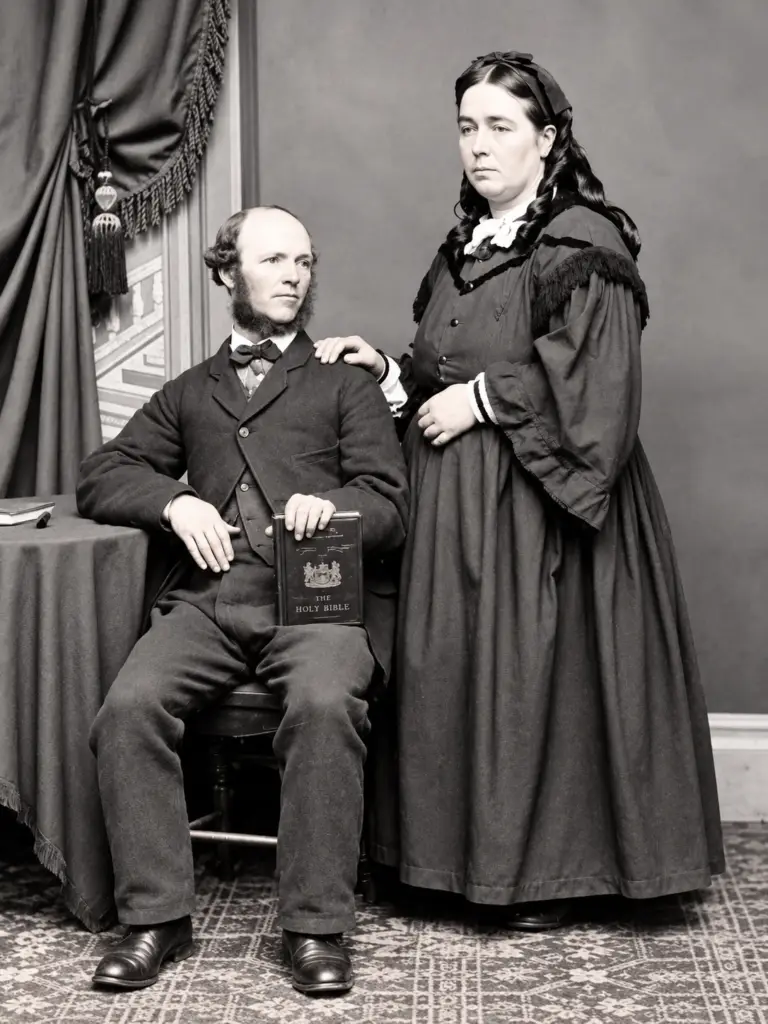
G6 - John Shiels (1826-1908) & Janet McNair
John Shiels (1826–1908), the fifth child of Thomas Shiels and Barbara Jean Cranston, was born on July 8, 1826, in Scotland. In 1850, he and his younger brother George left Scotland for Canada, eventually settling in Grey Township, Ontario, where John and his wife Janet McNair raised their family and established the Canadian branch of our direct Shiels line.
From Scotland to a New Life in Canada
John grew up at East Mains near Coulter, where his father Thomas worked for the Duke and where the Shiels family had established its home. According to the family history written by John’s son Jack Shiels in 1949, John attended the parish school until he was eleven years old. Jack later wrote that all the education his father received after that came from the “college of hard knocks.”
As a young boy, John was placed on a farm known as Hard Scrabble. Whatever hardships the name may suggest, Jack recalled that his father never complained. John apparently proved himself an able farm worker, and before he was twenty years old he had risen to the position of farm foreman, earning what Jack described as a very good wage for the time.
The experience John gained during these early years would serve him well. Before long, he and his younger brother George would leave the familiar countryside of Scotland and begin a journey that would change the course of the Shiels family forever.
The Voyage to Canada
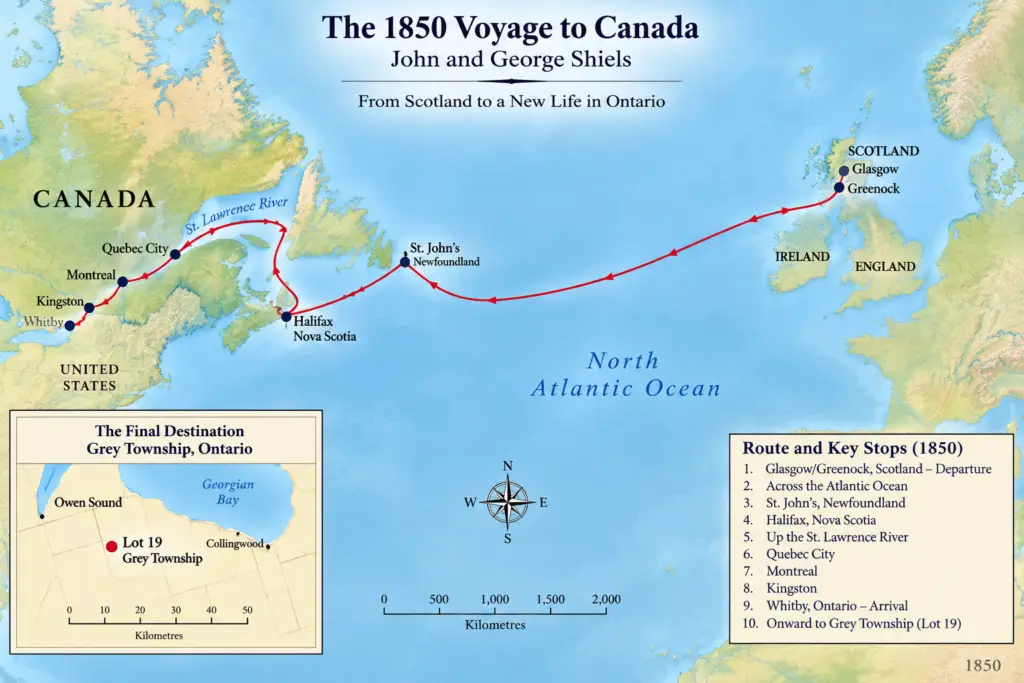
According to Jack Shiels’s 1949 family history, John and his younger brother George left Glasgow, Scotland, aboard the Morton to begin a new life in Canada. A newspaper account published during John and Janet’s lifetime records that John arrived in Canada in 1850, a date also preserved in the later history of Grey Township. Jack recalled that the voyage began on June 1 and that the crossing lasted until the middle of September.
Their Atlantic crossing was anything but uneventful. Jack wrote that a sudden squall struck the ship before the crew could reef the sails. Two of the ship’s masts were carried away, along with the sailors who were on them. The damaged vessel was forced to anchor for repairs, delaying the voyage for nearly three weeks.
Then another danger appeared. Smallpox broke out aboard the ship and, according to Jack’s account, eleven people died. John himself contracted the disease but survived.
After finally reaching Canada, the brothers continued westward to Whitby, Ontario, where they began the next chapter of their lives.
A New Beginning in Upper Canada
After reaching Canada, John and George made their way west to Whitby, Ontario. John was still recovering from smallpox and was not yet strong enough for heavy physical work. According to Jack Shiels, a friend named Andrew Archibald, a bricklayer and stonemason, helped John find work that he could manage while regaining his strength.
John remained with Archibald for about two years. He later accompanied him to a farm on the Huron Tract near Harpurhey, where John worked on the land and gained further experience that would soon prove invaluable.
By the spring of 1853, George had joined John again. Andrew Archibald advised the brothers to look farther north for land of their own. Acting on his advice, John and George set out on foot into the largely unsettled countryside that would eventually become their home.
Into the Bush — Grey Township, 1853
Early in May 1853, John and George set out northward in search of land. According to Jack Shiels, there were plenty of places along the way where a traveller could find something to drink, but after passing the Coombs place, there was nowhere to obtain a meal. Fortunately, the brothers had useful skills of their own: John was a good cook and George was a good shot, and Jack recalled that they “fared well.”
One of the first settlers they visited was Jim Douglas, whose family provided the travellers with a welcome meal of potatoes and venison. The brothers apparently never forgot the hospitality and, according to Jack, always had a good word for Mrs. Douglas afterward.
Continuing north, John and George eventually reached the McNiel shanty, where they spent the night. The following day they reached the land that would change the course of their lives. At the east corner stakes of Lots 19 and 20 on Concessions 14 and 15, the brothers cut their names into the stakes — their first claim upon the wilderness that would become home.
Carving a Farm from the Bush
Once they had chosen their land, John and George built a small shanty on the line between Lots 19 and 20 on the 14th Concession. Then came the enormous task of clearing the bush. Jack Shiels recalled that neither brother was particularly skilled with an axe when they began, “but they soon were.”
After getting their first start on the land, the brothers left for a time to work at the harvest. When they returned, decisions were made about which properties each would keep. John eventually settled on Lot 19, Concession 14, while George established his home on Lot 20, Concession 15.
The local history Grey Township and Its People, published in 1982, independently records that John settled on Lot 19, Concession 14 in 1853. It also records that George had pre-emption rights to his Lot 20 property as early as 1852 or 1853 and eventually received it from the Crown in 1865.
What began as heavily wooded land and a simple shanty would become the Shiels family farm. John would remain there for the rest of his life, and the property would remain home to members of his family for generations.
Lot 19, Concession 14 — The Shiels Homestead
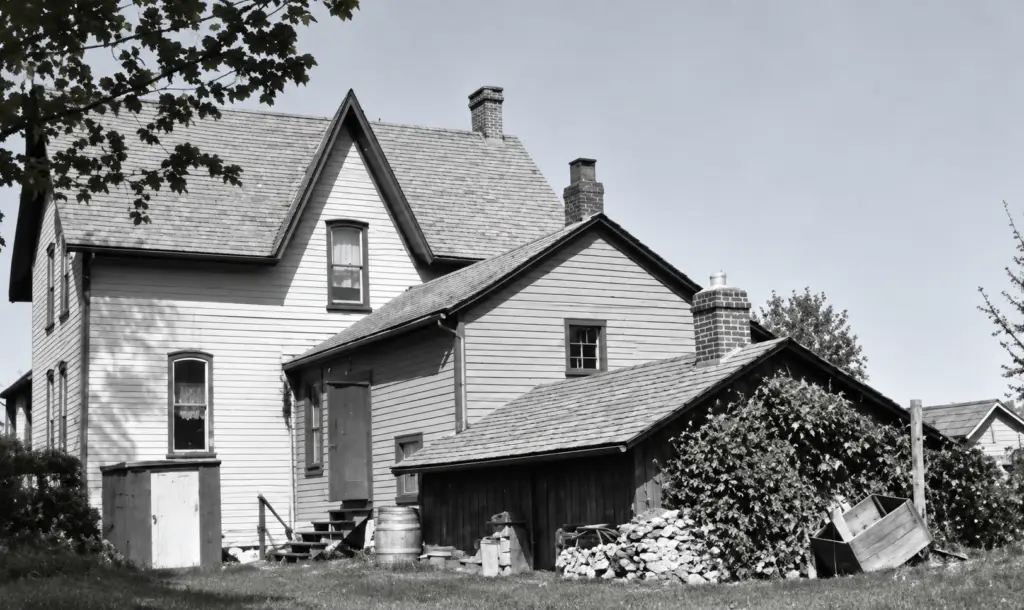
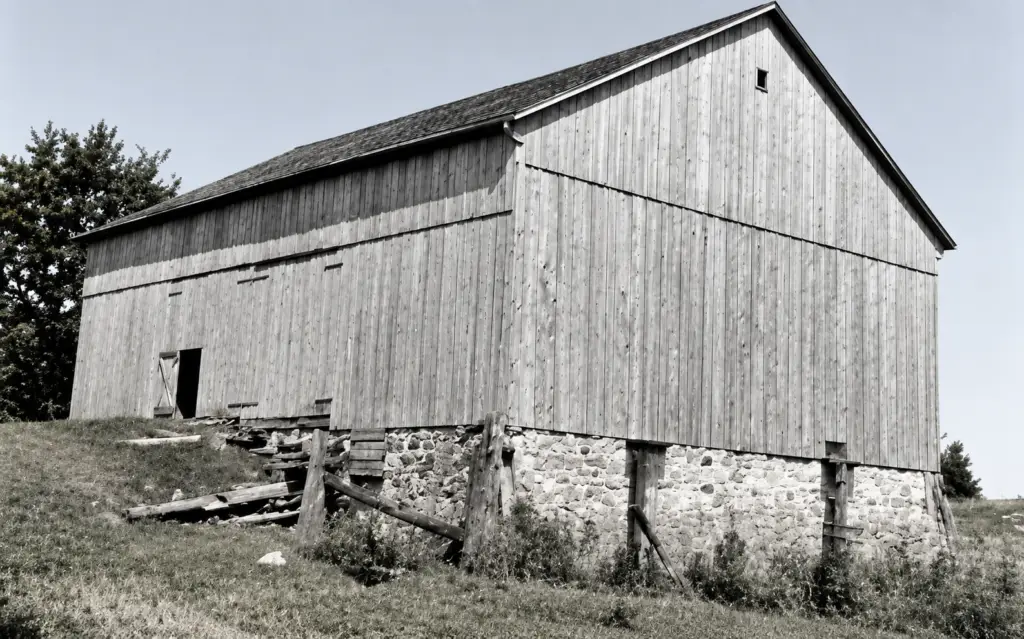
From the small shanty built in the bush in 1853 grew the permanent farmstead that John and his family created on Lot 19, Concession 14. A newspaper account published for John and Janet’s 50th wedding anniversary in 1907 records that their comfortable brick home had been built about twelve years earlier, around 1895. The house and barn shown above were built by the Shiels family and remained on the property until after the farm finally passed out of family ownership.
In 1982, John’s great-great-grandson Dan Shiels visited the old homestead and collected a brick from the house and a stone from the barn foundations — pieces of the family farm that he still preserves today. When he returned to the property in 1984, the buildings had been demolished and their remains buried.
John Shiels & Janet McNair — Building a Life Together
As John established his farm on Lot 19, another Scottish family was settling immediately next door. James McNair, a young immigrant from Scotland, secured Lot 20, Concession 14 in the fall of 1854. He then prepared to bring his parents, James and Jane McNair, and his sisters Janet and Jane from Scotland to join him.
With the McNairs living on the neighbouring farm, Janet became quite literally “the girl next door.” In time, she and John fell in love.
A newspaper account published for their 50th wedding anniversary in 1907 preserves the remarkable story of their marriage. John travelled by oxen to Clinton to obtain the marriage licence. Meanwhile Janet, accompanied by John’s brother George, walked 18 miles through the bush to Harpurhey to meet him. There the couple were married by the Rev. Mr. Barr. The following morning, John and his new bride travelled the same 18 miles back through the bush to begin their life together on the farm.
Their marriage began a partnership that would endure for half a century. Together they would transform John’s pioneer farm into a family home and establish the next generation of the Shiels family in Canada.
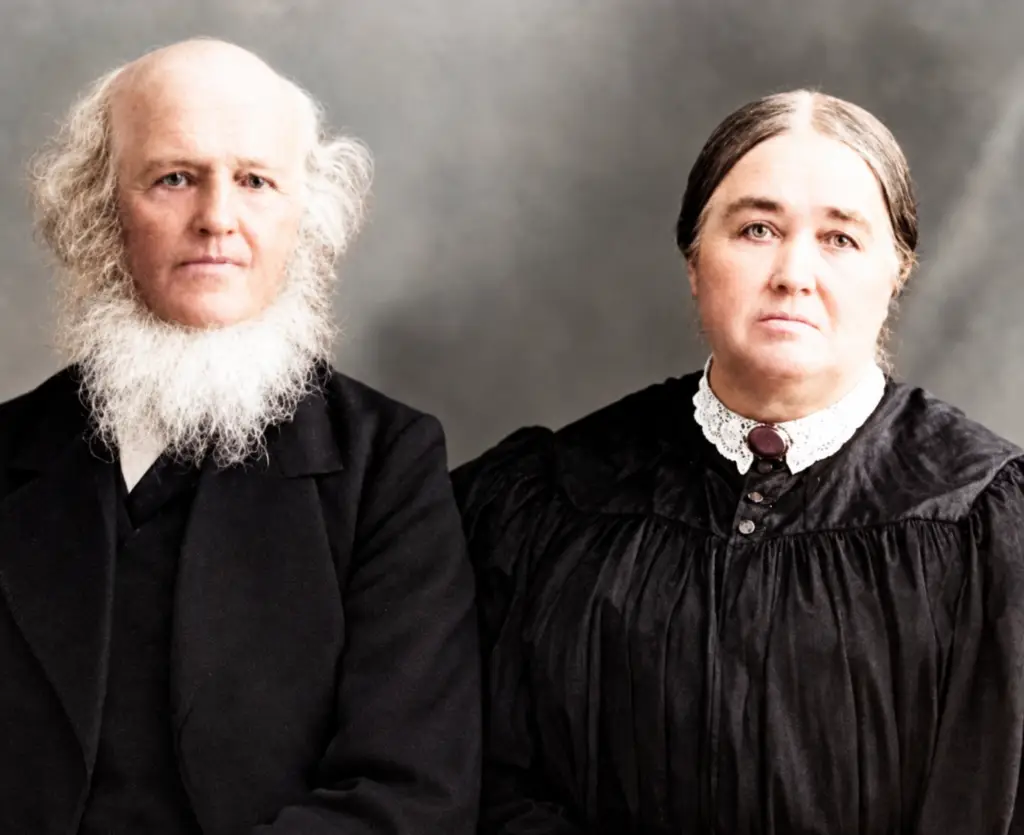
A Partnership on the Land
John and Janet began married life under conditions very different from those they had known in Scotland. Their home stood on land that only a few years earlier had been heavily wooded bush, and building a successful farm required years of hard work.
Janet was very much John’s partner in that work. Grey Township and Its People records that she worked side-by-side with her husband in the fields. Together they continued clearing and improving the land while raising their family on the farm John had first claimed in 1853.
More than forty years separate this later portrait from the young couple pictured at the beginning of this page. Through all those years, Lot 19, Concession 14 remained their home.
The Shiels Family at Lot 19
John and Janet raised their family of nine children on the farm at Lot 19, Concession 14. Two of their children died very young. As the children grew, the homestead remained the centre of family life. By the time this photograph was taken in 1899, their oldest son Thomas had married and established homes of his own, while the other children remained on the family farm. The youngest son William was married in 1901 and moved to British Columbia.
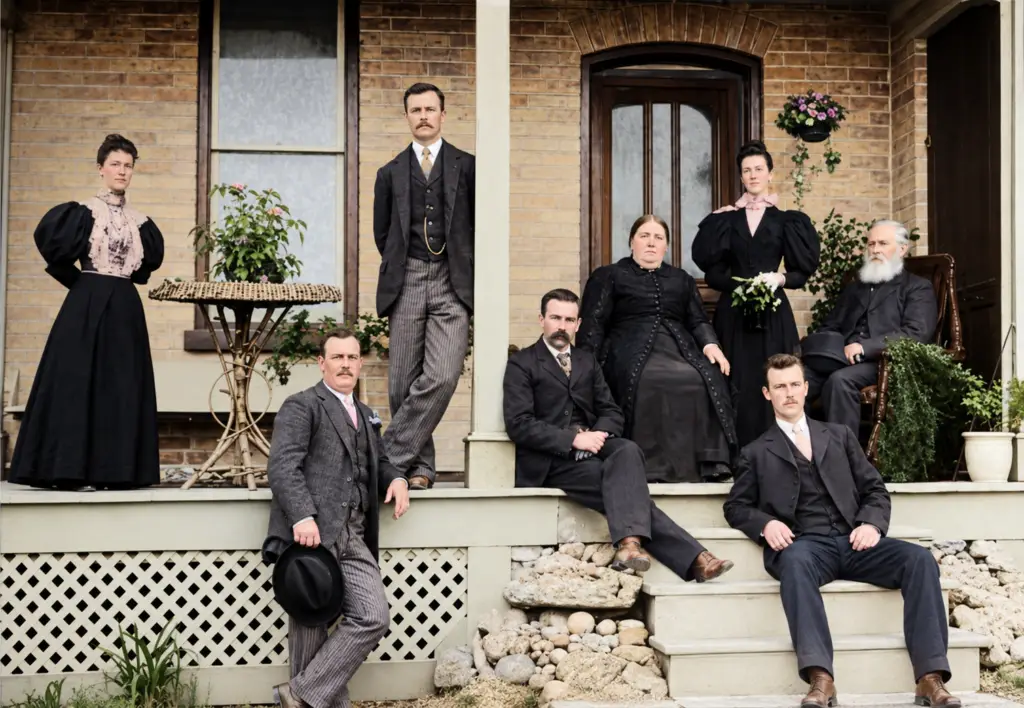
Janet and Her Stones
Life on the Shiels farm demanded hard physical work from everyone. Grey Township and Its People describes Lot 19 as an “extra stoney farm” and records that Janet worked side-by-side with John in the fields.
But Janet found something beautiful in the difficult ground they worked. She took particular delight in collecting coloured stones from the farm and arranging them beside the steps of the family home.
Family recollection adds another charming detail to the story. Janet was remembered as always wearing long dresses, and when she found stones that caught her eye, she would gather up the bottom of her dress to form a makeshift pouch, carrying her discoveries back to the house.
The stones became a distinctive feature of the homestead. They can be seen surrounding the steps in the 1899 family photograph above — and even more clearly in a later photograph of Janet standing outside the house.
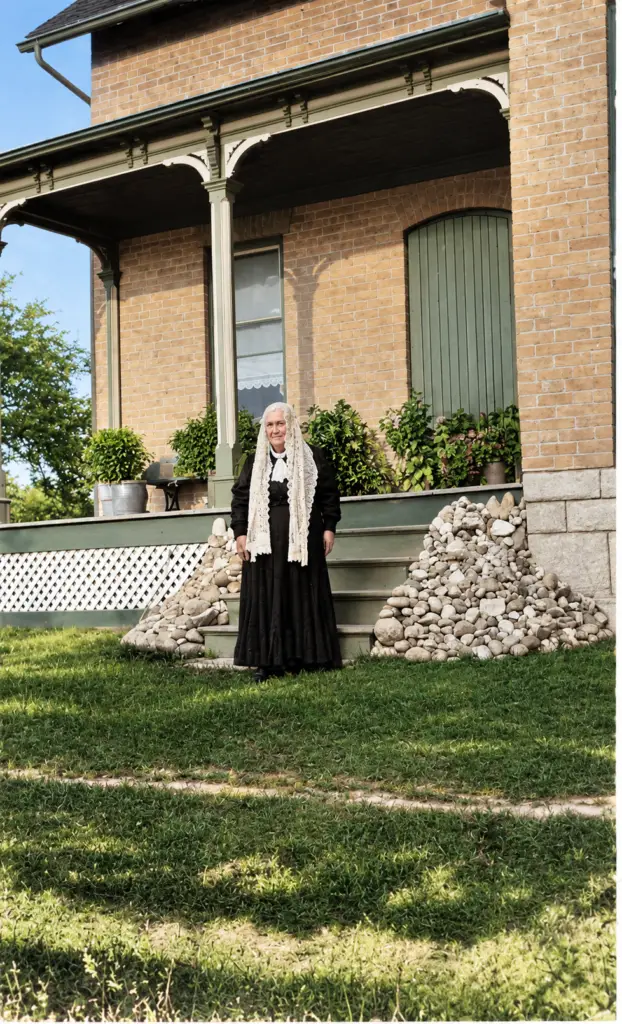
Fifty Years Together — 1907
On January 29, 1907, John and Janet Shiels celebrated their 50th wedding anniversary at the home they had built together in Grey Township. The occasion was important enough to be recorded in the local newspaper, which looked back on the remarkable journey that had brought them to this day.
Fifty years earlier, Janet had walked 18 miles through the bush to Harpurhey to meet the man she would marry. The following morning, the newlyweds travelled those same 18 miles back to begin their life together. Now, half a century later, they were surrounded by the farm, home and family that had grown from that beginning.
The newspaper described John, then about eighty years old, as retaining his faculties “to a marked degree” and still enjoying the recollection of the early scenes of his life. Janet, six years younger, had shared those years beside him.
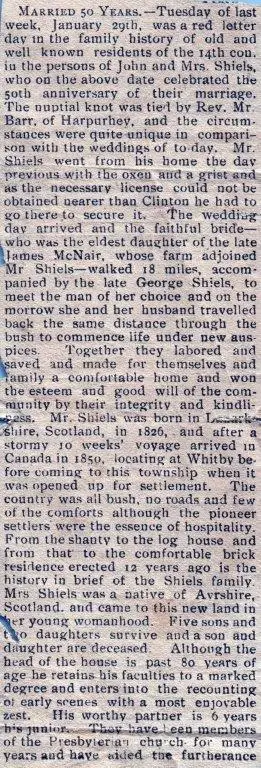
What the 1907 Newspaper Preserved
Written while John and Janet were still alive, the 1907 newspaper account provides a remarkable contemporary record of their lives. It confirms that John came to Canada in 1850, first settling at Whitby before making his way to Grey Township.
It also preserves the story of their courtship and marriage. Janet was the daughter of James McNair, whose farm adjoined John’s. To obtain their marriage licence, John travelled by oxen to Clinton, while Janet, accompanied by John’s brother George, walked 18 miles through the bush to Harpurhey. They were married there by the Rev. Mr. Barr and travelled the same distance back the following morning.
Looking around the farm fifty years later, the newspaper could measure what their labour had accomplished. It described the land John first encountered as all bush, without roads and with few comforts, but by 1907 the couple enjoyed a comfortable home. Their brick residence, the same house preserved in family photographs, had been built about 1895.
After half a century together, John and Janet had lived to see the wilderness homestead become an established family farm. Of their children, five sons and two daughters were still living when their golden anniversary was celebrated.
Golden wedding anniversary account, January 1907.
John Shiels — The End of a Remarkable Life
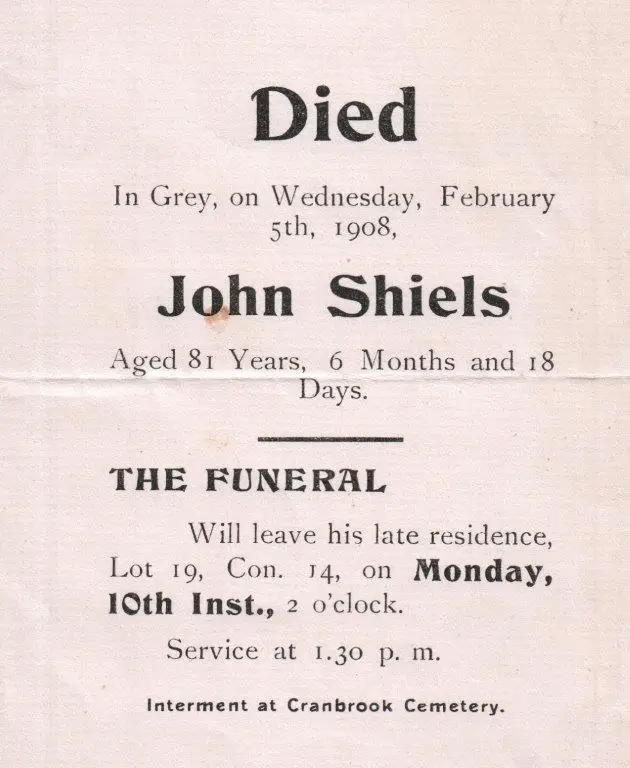
Just over a year after John and Janet celebrated their golden wedding anniversary, their long life together came to an end. John Shiels died on Wednesday, February 5, 1908, at the age of 81 years, 6 months and 18 days.
His funeral notice provides one final confirmation of the place that had defined so much of his life. The funeral was to leave “his late residence, Lot 19, Con. 14” — the same land John had entered as a young pioneer more than half a century earlier. He was laid to rest in Cranbrook Cemetery.
John had arrived in Grey Township when the country was still largely bush. He had helped clear the land, built a farm and home, raised a family with Janet, and lived long enough to see the wilderness around him transformed into an established farming community. Lot 19 remained his home until the end.
Janet — Life After John
After John’s death in 1908, Janet continued her life at the family home on Lot 19, surrounded by children who had shared much of their lives with their parents on the farm.
The farm that Janet had helped create was very different from the heavily wooded land John and George had first encountered more than half a century earlier. The bush had been cleared, the fields cultivated, and the small pioneer shanty had long since given way to the brick family home. Around its steps remained Janet’s collection of coloured stones — a small and very personal reminder of the years she had spent working that land.
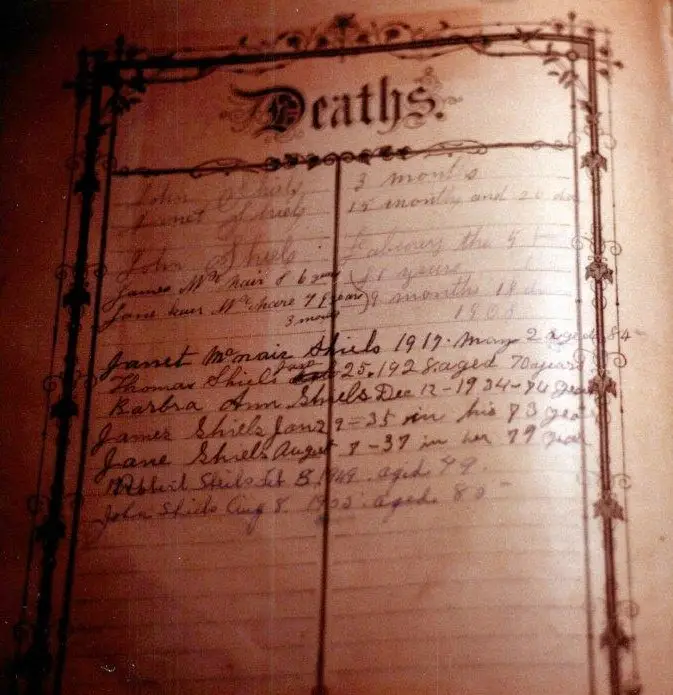
Janet outlived John by nine years. The Shiels family Bible records her death on May 2, 1917, at the age of 84. She had spent more than sixty years in Grey Township, watching a wilderness settlement become the home of succeeding generations of her family.
The Family Carries On
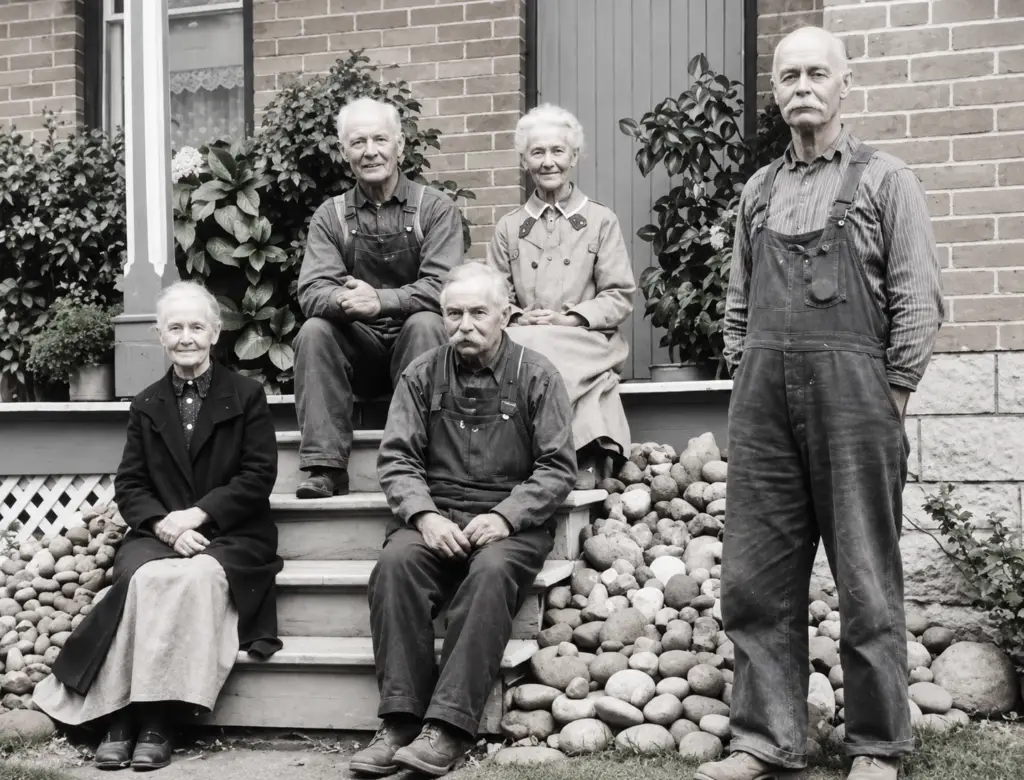
After John and Janet were gone, the family farm continued to bind their children together. Anne, Bob, James, Jane and Jack remained unmarried and continued to make their home at Lot 19, preserving a way of life that had begun when their father first entered the Grey Township bush in 1853.
But the Shiels story was already moving into another generation. While Anne, Bob, James, Jane and Jack remained together at Lot 19, their brother Thomas Shiels chose a different path. Like his father before him, Thomas left the familiar world of home in search of a life of his own — this time travelling west from Ontario to Manitoba and Saskatchewan. His younger brother William Shiels also went further west and settled in British Columbia.
The five unmarried children continued to make their home on the Grey Township farm for the rest of their lives. Only after Jack died in 1954, the last of the five, did the property finally pass out of the family when the land their father had carved from the bush was sold to a neighbouring farmer.
More than half a century earlier, John Shiels had left Scotland and crossed an ocean in search of opportunity. Now his son Thomas was looking westward across Canada. The destination had changed, but the impulse was much the same — to leave the familiar behind and build a life of his own.
Jack Shiels – Our Storyteller
Among John and Janet’s children was Jack Shiels, whose memories have accompanied us throughout parts of this story.
In 1949, at about eighty years of age, Jack recorded what became known within the family as Jack’s diary. He wrote what he remembered of his father, his family and the early years of the Shiels settlement in Canada. His recollections preserved personal stories about John’s life that would otherwise have been difficult, and in some cases impossible, to recover.
Jack was writing from memory and from stories passed down through the family, including those he had heard from his father. Although there was no way to verify many of these stories when Jack wrote his diary, they gave us the basis for our later research.
Without these stories, we simply would not have known where to start.
The Story Continues
It is interesting that out of nine children, only the oldest, Thomas and the youngest, William would marry. Thomas carried on the direct line recorded in this website while his brother William married and went to British Columbia.